

Overview
- Top
- Introduction
- Overview
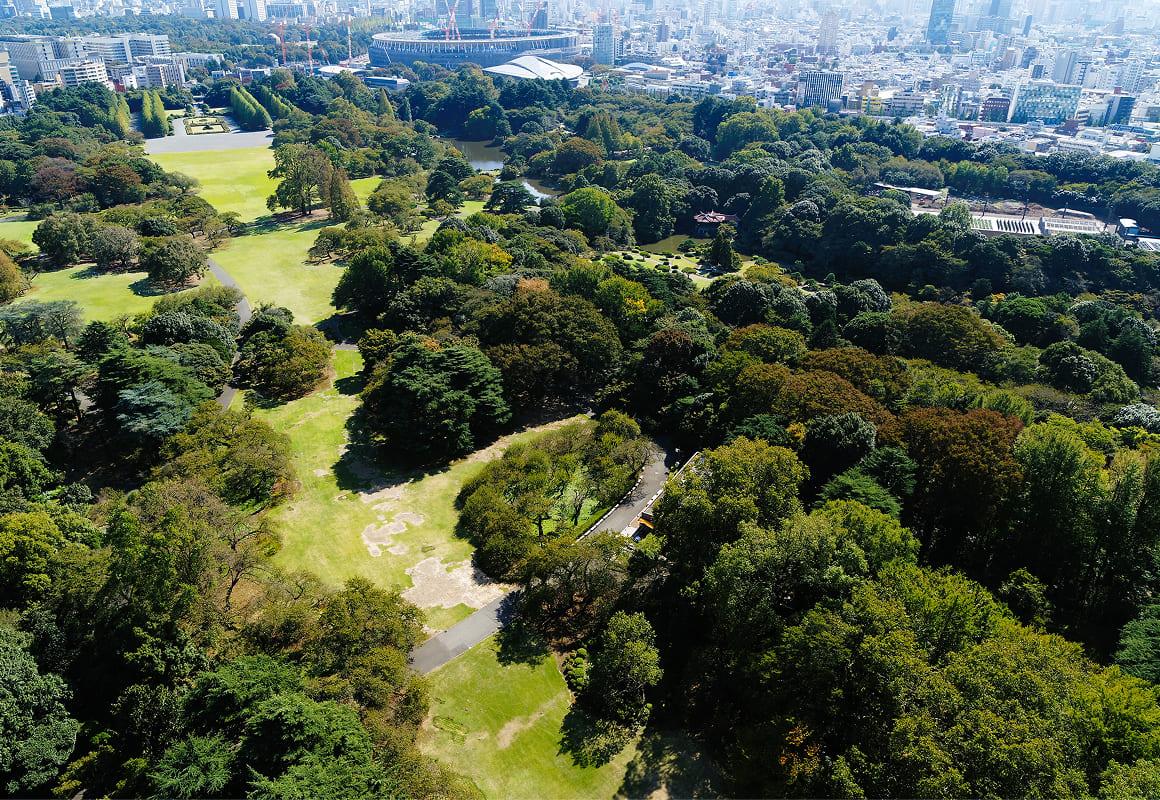
- Size
- 58.3 ha(145 acres)
- Number of annual visitors (2025)
- Around 2,820,000
- Number of trees on the garden grounds
- Around 10,000
- Varieties and numbers of cherry trees in the garden
- Around 70 varieties,
around 900 trees
- The Number of endangered plants conserved in the garden
- 140
(170 of the Japanese Red List species are conserved.)
A garden which spans Shinjuku and Shibuya wards, Shinjuku Gyoen has been loved by many people for many years. It makes an appearance in Kawabata Yasunari’s The Sound of the Mountain, when the protagonist, Ogata Shingo, declares, “It’s like getting out of Japan—I wouldn’t have dreamed that there was a place like this right in the middle of Tokyo.” The garden was largely burned down in the firebombing air raids near the end of World War II, but was rebuilt after the war and was opened to the public as Shinjuku Gyoen National Garden in 1949.
(For the detailed history, click here.)
![[Photo]Many visitors enjoy cherry blossom viewing in the landscaped garden during the cherry blossom season. A small child looks upward at the cherry blossoms in full bloom.](/national-garden/shinjukugyoen/intro/overview/images/img_02.jpg)
![[Photo] A view of the rows of plantain trees in the landscaped garden.](/national-garden/shinjukugyoen/intro/overview/images/img_03.jpg)
Shinjuku Gyoen covers an expansive area of 145 acres with a periphery that stretches for 3.5 km. It is widely known both in Japan and overseas as one of the best modern European-style gardens in Japan, artfully combining a diverse range of garden styles including the Formal Garden with its magnificent sycamore-lined avenue, the bright and open Landscape Garden with its spacious lawn with towering tulip trees, and the Japanese Traditional Garden.
Out of approximately 10,000 trees flourishing in Shinjuku Gyoen, the towering tulip trees, sycamores, Himalayan cedars, and bald cypresses particularly contribute to the garden’s extraordinary landscapes. Another large attraction of Shinjuku Gyoen is the nearly 900 cherry trees planted in the garden.
![[Photo]Cherry blossom season at Shinjuku Gyoen.](/national-garden/shinjukugyoen/intro/overview/images/spring.jpg)
![[Photo]It is the season of fresh greenery in Shinjuku Gyoen.](/national-garden/shinjukugyoen/intro/overview/images/summer.jpg)
![[Photo]Autumn foliage at Shinjuku Gyoen.](/national-garden/shinjukugyoen/intro/overview/images/autumn.jpg)
![[Photo]It's time for a snowy scene at Shinjuku Gyoen.](/national-garden/shinjukugyoen/intro/overview/images/winter.jpg)
Shinjuku Gyoen’s Key Visual
A look at the history of Shinjuku Gyoen reveals that its founders learned greenhouse cultivation techniques for grapes, orchids, and other plants from places such as France and Germany, and drew inspiration from French landscaping principles when designing the garden.
Significant development of the garden occurred through exchanges with the West during the Meiji era, evolving it beyond the framework of what is typically considered a “Japanese park.”
To this day, Shinjuku Gyoen comprises both Western-style and Japanese-style gardens, serving as a place where both Japanese and international visitors alike may encounter different cultures.
Thus, Shinjuku Gyoen has been shaped by exchanges between the East and West.
It will continue to evolve as a place where the East and West meet.
This concept is conveyed through an organic logotype consisting of Japanese and Western characters facing each other, creating the impression of lush vegetation.
The ornament positioned between the two symbolizes the ties between the East and West.
Its design incorporates motifs of plants that bring color to Shinjuku Gyoen in each season: chrysanthemums, cherry blossoms, orchids, ginkgo tree leaves, camellias, and tulip tree leaves.
The ornament positioned between the two symbolizes the ties between the East and West.