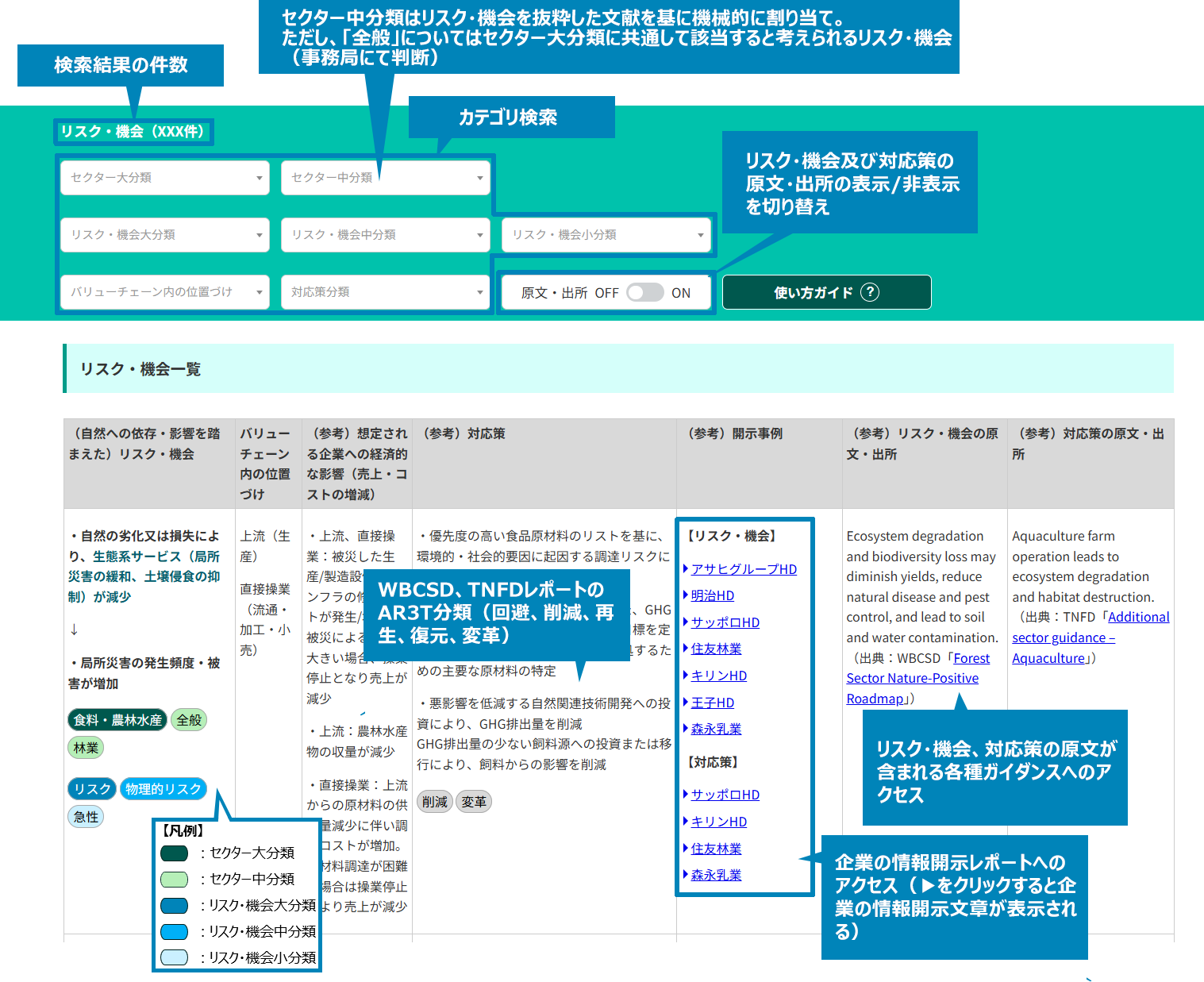
| (自然への依存・影響を踏まえた)リスク・機会 | バリューチェーン内の位置づけ | (参考)想定される企業への経済的な影響(売上・コストの増減) | (参考)対応策 | (参考)開示事例 | (参考)リスク・機会の参考文献・引用 | (参考)対応策の参考文献・引用 |
|---|---|---|---|---|---|---|
|
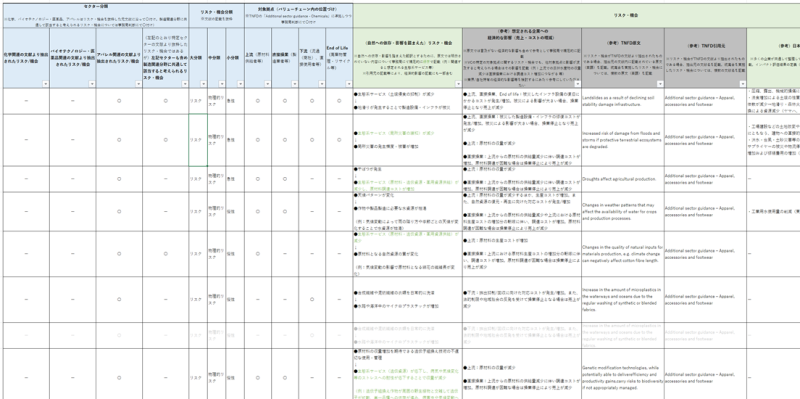
・自然の劣化又は損失により、生態系サービス(局所災害の緩和、土壌侵食の抑制)が劣化 ↓・局所災害の発生頻度・被害が増加 食料・農林水産 全般 林業 リスク 物理的リスク 急性 |
|
|
削減 変革 |
【リスク・機会】
【対応策】
|
Degradation of nature and subsequent loss of natural protection exacerbates severity of damages from extreme weather such as cyclones, droughts, flooding, and storms.
Increase in production and sourcing costs due to agricultural product volatility, e.g. tropical storms in the Caribbean affecting sugar cane crops, creating shortages or price increases for the rum industry; heatwaves creating CO2 shortages affecting the carbonation process for soft drinks producers. |
Develop a strategy to discuss sourcing risks, due to environmental and social considerations, from a list of priority food ingredients.
Reduce GHG emissions by investing in nature-relatedtechnology development that reduce negative impacts.Reduce impact from feed by investing in or shifting to feedsources with lower GHG emissions.
Invest in pesticide efficiency technologies and environmentallyfriendly pest control. |
|
・農林水産物及び家畜に影響を及ぼす病害虫が発生/増加 ↓・生態系サービス(食料・原材料・遺伝資源供給)が劣化(=農林水産物の収量が減少) 食料・農林水産 全般 農業 林業 水産業 リスク 物理的リスク 急性 |
|
|
|
【リスク・機会】
【対応策】
|
Increased occurrence of diseases and pests affecting tree species may result in widespread destruction or reduction in yield.
Revenue reduction due to increase in crop and livestock pests and disease.
Disease or pests affecting the species or variety of crop the organisation relies on. |
Invest in pesticide efficiency technologies and environmentallyfriendly pest control. |
|
・生態系の劣化や生物多様性の損失により、生態系サービス(生物学的コントロール、水質浄化)が劣化 ↓・病害虫や土壌・水質汚染が発生/増加し、農林水産物の収量が減少 (例:養殖場の運営により生態系が劣化し、水質汚染が発生することにより、生産量が減少するほか汚染修復にかかるコストが発生) 食料・農林水産 全般 林業 水産業 リスク 物理的リスク 急性 |
|
|
削減
復元 再生
再生
削減
回避
削減 変革
回避 変革 |
【リスク・機会】
【対応策】
|
Ecosystem degradation and biodiversity loss may diminish yields, reduce natural disease and pest control, and lead to soil and water contamination.
Aquaculture farm operation leads to ecosystem degradation and habitat destruction. |
Reduce operational GHG emissions, water use (especially in water-stressed areas) & water pollution from processing & food manufacturing
Restore areas of significant biodiversity and carbon value
Develop a strategy to manage environmental and social risks arising from contract growing and commodity sourcing
Supplier land protection and deforestation-free programmes: Regularly assess the land usage and management practices (e.g. regenerative agriculture) of suppliers and encourage them to set and meet specific deforestation-free targets/ask for certifications.
Implement policies and commitments to reduce or eliminateagricultural-driven natural ecosystem conversion with specifiedtargets and cut-off dates for the organisation’s own production,sourcing of animal feed, and products sourced for aggregation,processing or trade.
Implement policies and commitments to reduce or eliminateagricultural-driven natural ecosystem conversion with specifiedtargets and cut-off dates for the organisation’s own production,sourcing of animal feed, and products sourced for aggregation,processing or trade.
Create a plan with time-bound targets for the reduction of landfootprint and increase land use efficiency from own productionand sourcing of agricultural produce. (See Science BasedTargets Network for more on land-based target setting).
Set landscape-level targets for key supply sheds and sourcingregions to enable regenerative, restorative and transformativeactions in collaboration with primary producers and key supplychain participants.
Reduce erosion by implementing buffer zones with naturalvegetation between the aquaculture farm and naturalwaterbodies.
Organisations should ensure that none of the farm(s)they source from are sited in a Protected Area or HighConservation Value Area as farm siting can influence thesurrounding ecosystems.
Reduce risk to wild populations and escapes by transitioning to pond/tank systems to allow for wastewater treatment and prevent the escape of farmed species.
Avoid the potential spread of non-indigenous species from aquaculture farms with all the related consequences, such as possible population outbreaks:• Locate open ocean farms to areas with no sensitive wild fish populations; • For land-based aquaculture, invest in recirculating (RAS) systems as they are less open to the environment;• Install monitoring systems to control and prevent possible escapes and any kind of damage to the farm• Use farming equipment that will withstand rare instances of storms or hurricanes;• Establish an escape management plan that includes specific procedures to apply in the event of an escape. This should include the implementation of international and national regulations that control the handling of non-indigenous species to limit the risk of detrimental effects from their intentional introduction and transfer in marine waters (e.g. Code of Practice on the Introductions and Transfers of Marine Organisms by the International Council for the Exploration of the Sea, ICES 2005). |
|
・土壌侵食により生態系サービス(局所災害の緩和)が劣化 ↓・特定の季節に発生しやすい暴風雨・洪水・干ばつによる農林水産物の収量減少が悪化 食料・農林水産 農業 リスク 物理的リスク 急性 |
|
|
再生 |
Seasonal crop loss due to storms, floods, & droughts worsened by soil loss |
Transition to regen-ag to improve soil health, biodiversity & carbon sequestration (e.g., crop rotation, cover crops, low/no-till, bio-based inputs, ICLFS) |
|
|
・生態系サービス(水流の調整及び浄水を含む水供給)が劣化 ↓・水ストレスが上昇し、農林水産物の生産・調達コストが増加 食料・農林水産 全般 農業 リスク 物理的リスク 急性 |
|
|
|
【対応策】
|
Increase in production and sourcing costs due to high or extremely high baselinewater stress. |
Avoid establishing new operations in/adjacent to areas of significant biodiversity value or in water-stressed regions
Supplier water stewardship programmes: Collaborate with suppliers to improve their water management practices, e.g.shared best practices, capacity building and trainings, encouraging certifications, joint research.
Commit to providing support to smallholder producers to helpthem enter responsible supply chains and improve their yieldsand production practices. |
|
・生態系サービス(局所災害の緩和、土壌浸食の抑制)が劣化 ↓・局所災害の発生頻度・被害が増加し、保険会社が損害保険料を引き上げることで、コストが増加 食料・農林水産 全般 農業 リスク 物理的リスク 慢性 |
|
|
【リスク・機会】
|
Increased climate hazard insurance costs due to decreased climate and hazardregulating ecosystem services (storm regulation, local (micro and meso) climateregulation, flood mitigation, soil and sediment retention etc). |
||
|
・気候変動により生態系サービス(局所災害の緩和)が劣化 ↓・局所災害の発生頻度・被害が増加することで、樹木のレジリエンス(成長・生存)に影響が発生 (例:洪水の発生頻度・被害が増加することで、原材料となる樹木の供給が困難となる) 食料・農林水産 全般 林業 リスク 物理的リスク 慢性 |
|
|
|
【リスク・機会】
|
Changing climatic conditions and severe weather events may affect resilience, growth and survival of tree species and intactness of company operations in general. |
Restore native or endangered species adapted to local conditions
Restore native or endangered tree species adapted to climatic conditions |
|
・気候変動や侵略的外来種の増加により生態系サービス(食料・原材料・遺伝資源供給、水流の調整及び浄水を含む水供給)が劣化 ↓・水や繊維等の主要な自然資源が枯渇 食料・農林水産 全般 林業 リスク 物理的リスク 慢性 |
|
|
|
Increased scarcity of key natural inputs, such as water and fiber, due to climate change and invasive species proliferation. |
Reduce climate change induced pressures
Implement species mapping and management programmes
Reduce pressures from invasive species
Adopt sourcing practices that require that ingredient value chain suppliers engage in mitigation measures to manage water risks.
Implement strategy and practices to manage risk of invasivespecies already introduced into the region of the company area ofoperation.
Reduce drivers related to introduction of invasive alien species |
|
|
・土壌劣化により生態系サービス(局所災害の緩和、地力の維持及び栄養循環)が劣化 ↓・土地の資産価値が低下。また、農林水産物の収量が減少するほか品質が低下。加えてサプライチェーンの混乱・断絶等により下流側の企業に利益損失が発生 (例:原材料調達不可による操業停止) 食料・農林水産 農業 リスク 物理的リスク 慢性 |
|
|
再生
削減
再生 |
【リスク・機会】
【対応策】
|
Loss & variability in volume & quality of yield due to soil degradation
Decreasing land productivity and climate hazard regulation services as a result of soil health degradation leads to profit loss for farmers due to yield losses and todownstream corporations due to supply chain disruption.
Asset devaluation due to proportion of land with soil degradation. |
Transition to regen-ag to improve soil health, biodiversity & carbon sequestration (e.g., crop rotation, cover crops, low/no-till, bio-based inputs, ICLFS)
Protect soil quality
Expand sustainable production on degraded lands (e.g., degraded pasture) |
|
・生態系サービス(地力の維持及び栄養循環、水質浄化)が劣化 ↓・土壌・水質汚染や水不足が発生し、汚染修復や自然資源の復元・再生に向けた対応コストが発生/増加 (例:水浄化および脱塩技術、土壌浄化技術への資本支出の増加) 食料・農林水産 農業 リスク 物理的リスク 慢性 |
|
|
再生
|
【リスク・機会】
|
Increased costs from greater need for inputs & ops adjustments in response to soil degradation
Increase in capital expenditure on water purification and desalination technologiesand soil cleaning technologies due to pollution concentration and water stress.
Increase in production and sourcing costs due to dependency on agriculturalproducts (including meat, dairy and poultry) from areas with concentration of waterpollutants. |
Transition to regen-ag to improve soil health, biodiversity & carbon sequestration (e.g., crop rotation, cover crops, low/no-till, bio-based inputs, ICLFS)
Avoid sourcing raw materials and forest products without robust due diligence and traceability systems
Portfolio adjustment: Evaluate the water footprint of different products and prioritise or promote those with lower water impacts. |
|
・授粉媒介動物が減少(=生態系サービス(花粉媒介)が劣化) ↓・結実・結種不良が発生することで農作物の収量が減少。また、機械的人工授粉・手動人工授粉の必要性が高まることで、農産物の生産コストが増加 食料・農林水産 農業 リスク 物理的リスク 慢性 |
|
|
Increase in capital expenditure for mechanical and/or hand pollination due to declinein natural pollinators. |
|||
|
・農地の農薬や水中の化学物質の蓄積により、生態系サービス(地力の維持及び栄養循環、水質浄化)が劣化 ↓・農地の生産性が低下することで、農作物の収量が減少。また、土壌・水質汚染が発生することで土地の資産価値が低下するほか、汚染修復に向けた対応コストが発生/増加 食料・農林水産 農業 リスク 物理的リスク 慢性 |
|
|
削減
再生
|
Land asset depreciation due to productivity decline from soil degradation
Costs associated with the relocation of agricultural operations and agriculturalproduct suppliers due to lost productivity of agricultural land.
Land asset depreciation due to pesticide land concentration/soil health condition andwater chemical and nutrient concentration. |
Reduce operational GHG emissions, water use (especially in water-stressed areas) & water pollution from processing & food manufacturing
Develop and adhere to an Integrated Pest Management Plan, inline with best practices from the International Code of Conducton Pesticide Management, to prevent, mitigate and remediatenegative impacts associated with the use of hazardouspesticides and excess pesticide use.
Transition to regen-ag to improve soil health, biodiversity & carbon sequestration (e.g., crop rotation, cover crops, low/no-till, bio-based inputs, ICLFS)
Create a soil management plan that identifies main threats to soilhealth, describes soil management practices used and outlinesan approach to input optimisation, including the use of fertilisers.
Establish a plan with time-bound targets to reduce excessfertiliser use intensity per fertiliser nutrient type (N, P_{2} O_{5} , K_{2} O)with an open methodology for the specific production system. |
|
|
・高品質な自然関連データの活用が困難。また、規制当局が新たなモニタリング技術の導入を要求 ↓・自然関連評価が低下するほか、モニタリング技術に関するコストが発生/増加 食料・農林水産 全般 林業 リスク 移行リスク 技術 |
|
|
Lack of access to (high quality) data that hampers nature-related assessments. Regulators demanding the usage of new monitoring technologies that are costly to implement. |
|||
|
・環境配慮技術への移行を要求される ↓・環境配慮技術への移行コストが発生/増加。競合に比して移行が遅れた場合、市場シェアが減少 (新技術例:①精密農業技術導入への移行、②再生型農業手法への移行、③水需要の少ない作物品種への移行、④低排出の代替飼料オプションへの移行、⑤化学物質使用量削減手法への移行、⑥持続可能な包装への移行、⑦食品ロスと廃棄物の削減を可能にするシステムへの移行) 食料・農林水産 全般 農業 林業 リスク 移行リスク 技術 |
|
|
回避 削減 復元 再生 変革 |
【リスク・機会】
|
Transition to more efficient and cleaner technologies with lower nature impacts.
Expenditure on precision farming technologies/regenerative farming practices/cropvarieties with lower water needs/alternative fodder options with low emissions to air etc.
Failure of nature-friendly technological innovation and loss of market share (e.g.reduced water use/re-use, chemical usage, sustainable packaging, renewable energy). |
Reduce water use and waste in nurseries and forests
Enhance products lifetime
Upgrade equipment: Replace old machinery and pipelines with more water-efficient models.
Advanced water metering and monitoring: Use smart water management systems to monitor and control water usage, identifying areas for improvement and reducing wastage.
Developing water-neutral products and water replenishment:Innovate to create products that require less water in their production, and explore compensating for the water used through replenishment projects
Develop nature-positive ingredients, products & campagins (i.e., DCF, regenerative, organic, plant-based, etc.) |
|
・生態系サービス(食料・原材料・遺伝資源供給)が劣化 ↓・原材料調達における競争が激化し、資源が希少化することで、調達コストが変動・増加 食料・農林水産 全般 林業 リスク 移行リスク 市場 |
|
|
【リスク・機会】
【対応策】
|
Volatility or increased costs of materials due to increased competition or scarcity (e.g., increased price of timber can result in additional revenue, or increased costs depending on where the company is in the value chain). |
||
|
・顧客の嗜好変化への対応が遅れる ↓・売上が減少 (例:顧客が環境再生型農業での生産食品や植物由来で持続可能に生産されたタンパク質、環境に優しいプラスチック包装を嗜好するようになった際に、競合に比して対応が遅れた場合は売上が減少) 食料・農林水産 全般 農業 リスク 移行リスク |
|
|
回避 削減 復元 再生 変革
再生
回避 削減 復元 再生 変革 |
【リスク・機会】
|
Potential downstream reputational/market risk (e.g., GMO perception)
Shifting customer values or preferences to products with perceived lower impacts on nature may decline demand for certain forest products (e.g., away from single-use forest products) while increasing demand for others (e.g., increased demand for timber in construction).
Loss of market share due to shifting of customers' preferences to products and services that have positive impacts on nature, mitigate negative impacts or have lower nature dependencies (e.g. packaging).
Market share loss due to increasing consumer preferences for food produced viaregenerative practices and/or for plant based, sustainably produced protein.
Market share loss due to slow adoption of environmentally friendly plastic packaging. |
Implement strategies to manage the use of genetically modifiedorganisms (GMOs).
Develop nature-positive ingredients, products & campagins (i.e., DCF, regenerative, organic, plant-based, etc.)
Transition to regen-ag to improve soil health, biodiversity & carbon sequestration (e.g., crop rotation, cover crops, low/no-till, bio-based inputs, ICLFS)
Develop nature-positive ingredients, products & campagins (i.e., DCF, regenerative, organic, plant-based, etc.) |
|
・事業活動が自然に悪影響を与えた場合、顧客・投資家・地域等からの評判が低下 ↓・売上が減少するほか、市場へのアクセスが制限される (例:環境基準を満たさないとして販売契約を解除される) 食料・農林水産 全般 農業 リスク 移行リスク |
|
|
回避 削減 復元 再生 変革
|
【リスク・機会】
【対応策】
|
Loss of revenue or reduced access to markets if activities linked to negative environmental impacts |
Develop nature-positive ingredients, products & campagins (i.e., DCF, regenerative, organic, plant-based, etc.)
Avoid sourcing raw materials and forest products without robust due diligence and traceability systems |
|
・環境再生型農業へ移行 ↓・移行期間において、短期的に農作物の収量が低下するほか、投入資源および事業運営コストが増加 (例:化学肥料や除草剤の使用を減らして被覆作物や輪作を導入した場合、初年度は土壌が安定していないため収量が減少するほか、被覆作物等の種子や新たな農機具の購入でコストが増加) 食料・農林水産 全般 林業 リスク 移行リスク 市場 |
|
|
Increased inputs & ops costs due to potential lower yields (short-term) in transition to regen-ag
Amount of input used in the production process (ecosystem service) |
|||
|
・森林破壊ゼロ・土地転換ゼロ(DCF)を目指して、限られた土地の有効利用・適正管理を促進する政策が推進される ↓・農作物の供給量が減少し、調達コストが増加 食料・農林水産 農業 リスク 移行リスク |
|
|
回避 削減 |
Reduced supply & increased cost of commodities due to DCF & “land-sparing” policies & commitments |
Support & incentivize DCF production in sourcing locations, in line with biome-specific guidelines & cutoff dates |
|
|
・食料産品がバイオエコノミーおよびバイオ燃料需要と競合する ↓・食料産品の供給量が減少し、調達コストが増加 (例:バイオ燃料の需要が増加し、トウモロコシの多くが燃料用に回されることで食品用の供給量が減少) 食料・農林水産 農業 リスク 移行リスク |
|
|
Reduced supply & increased cost of food commodities due to competition with bioeconomy & biofuel demands |
|||
|
・事業活動が自然に悪影響を与える ↓・資産の継続利用が困難となり、資産の減損処理や早期廃棄(いわゆる「座礁資産」)が発生 食料・農林水産 全般 農業 リスク 移行リスク |
|
|
回避 削減 復元 再生 変革 |
Write-offs & early retirement of existing assets (i.e., “stranded assets”) if activities linked to negative environmental impacts |
Develop nature-positive ingredients, products & campagins (i.e., DCF, regenerative, organic, plant-based, etc.) |
|
|
・事業活動が自然に悪影響を与える ↓・資本コストが増加するほか資金調達が制限される (例:融資条件の厳格化、金利の上昇、借入枠の縮小) 食料・農林水産 全般 農業 リスク 移行リスク |
|
|
回避 削減 復元 再生 変革
|
【リスク・機会】
【対応策】
|
Increased cost of capital or reduced access to financing (debt & equity) if activities linked to negative environmental impacts
Missed investment opportunities, poor ratings and negative brand perception due to failure to adhere to sustainability standards, including mandatory frameworks.
Decline in brand perception |
Develop nature-positive ingredients, products & campagins (i.e., DCF, regenerative, organic, plant-based, etc.)
Avoid sourcing raw materials and forest products without robust due diligence and traceability systems
Undertake an annual strategic review of nature-related issues at the board level. |
|
・従来型の肥料・農薬の需要が減少 ↓・売上が減少 食料・農林水産 農業 リスク 移行リスク |
|
|
回避 削減 再生 |
Potential for lost revenue from reduced demand for conventional fertilizers & pesticides |
Develop & deploy agri-inputs (e.g., bio-based materials), technologies (e.g., improved MRV) & services to drive sustainable intensification & regen-ag outcomes |
|
|
・新しい農業手法を導入 ↓・農業保険の適用が除外されるほか、保険・資金調達コストが増加 食料・農林水産 農業 リスク 移行リスク |
|
|
Loss or increased cost of crop insurance coverage & financing for new farming practices |
|||
|
・地域またはサプライチェーン下流の自然に悪影響を与える ↓・特定地域において操業許可を喪失(=操業停止) 食料・農林水産 全般 農業 リスク 移行リスク |
|
|
【リスク・機会】
【対応策】
|
Loss of community license to operate due to local or downstream environmentalironmental degradation |
||
|
・自然関連情報開示に関する規制・要求が厳格化 ↓・自然関連情報開示の実施に必要なデュー・ディリジェンス、モニタリング、報告等に要するコストが増加 食料・農林水産 全般 農業 リスク 移行リスク |
|
|
|
【リスク・機会】
【対応策】
|
Increased due diligence & reporting costs to comply with nature-related disclosure frameworks |
Establish a strategy to ensure that suppliers conform to social and environmental responsibility audits and correct major and minor non-conformances. |
|
・自然関連の評判低下により、サプライヤーや顧客のロイヤリティが低下 ↓・サプライヤーからの調達が困難になるほか、製品需要・売上が減少。また、従業員の定着率が低下 食料・農林水産 全般 農業 林業 水産業 リスク 移行リスク 評判 |
|
|
回避 削減 復元 再生 変革
削減
変革
|
【リスク・機会】
【対応策】
|
Shift of consumer sentiment away from organizations/brands/products with a poorly perceived nature management leading to reduced demand for products, reduced supplier or off-take loyalty, or reduced employee retention.
Shifts in consumer sentiment towards the organisation/brand as a result of use of environmentally harmful inputs.
Loss in revenue due to reputational damage caused by business contamination ofground water, eutrophication, plastic pollution, deforestation and/or emissions. |
Develop nature-positive ingredients, products & campagins (i.e., DCF, regenerative, organic, plant-based, etc.)
Avoid sourcing raw materials and forest products without robust due diligence and traceability systems
Reduce operational GHG emissions, water use (especially in water-stressed areas) & water pollution from processing & food manufacturing
Reduce plastic pollution from aquaculture by: • Reinforcing current farm waste management indicators with specific criterion on marine litter and aquaculture gear management;• Implementing five Rs: Reduce, Reuse, Recycle, Recover and Refuse;• Developing scientific knowledge on the impacts of aquaculture gear and plastic waste management and provide practical solutions;• Aligning with proposed criteria for SDG14 (Life below water) practical solutions, which include implementing traceability systems (coding aquaculture gear and provide master list), controlling and recording plastic retention devices at the effluent or discharge point, and the proper disposal of aquaculture gear and plastic materials after use;• Procure equipment with recycled plastics as opposed to virgin plastics.
Waste management improvements (organic waste, water, materials): Implement systems for reducing, reusing, and recycling waste materials generated from production processes. This includes organic waste, water, and traditional packaging materials, e.g. • Returnable and refillable plastic systems, recycling and recycled content; • Waste water treatment and re-use (e.g. irrigation, share with third parties). |
|
・水不足地域で環境へ悪影響を与える ↓・地域・社会からの強い反発を受けて操業停止となり売上が減少。また、評判回復のためのコストが発生/増加 (例:水不足地域における水資源の過剰使用により、地域からの反発を受けて操業停止となる) 食料・農林水産 農業 リスク 移行リスク 評判 |
|
|
削減 |
Revocation of operating licenses and reputational expenses following environmental damages in water-scarce regions already facing social challenges (e.g. limiting water access for communities). |
Reduce operational GHG emissions, water use (especially in water-stressed areas) & water pollution from processing & food manufacturing |
|
|
・事業活動が自然へ悪影響を与える ↓・法的罰則/訴訟コストが発生。罰則や訴訟の内容によっては操業停止となり売上が減少 (例:農薬、抗生物質、肥料の使用や窒素効率要件に関する規制基準を満たせなかった場合に罰金が発生) 食料・農林水産 全般 農業 リスク 移行リスク 政策 |
|
|
回避 削減 復元 再生
|
【リスク・機会】
|
Costs of jurisdictional penalties/ litigation for activities linked to negative environmental impacts
Increase in fines due to failure to meet regulatory limits on pesticide/ antibiotics/fertiliser use and/or nitrogen efficiency requirements. |
Develop nature-positive ingredients, products & campagins (i.e., DCF, regenerative, organic, plant-based, etc.)
Use supplier contracts that stipulate that ingredient suppliers need to have a company policy that states it will prohibit the use of pesticides banned by the World Health Organization or the Food & Drug Administration.
Commit to a zero-tolerance approach to violence and threatsagainst forest, land and human rights defenders.
Establish an operational-level grievance mechanism inconsultation and collaboration with relevant stakeholders.
Avoid sourcing raw materials and forest products without robust due diligence and traceability systems
Invest in precision technologies to increase nutrient useefficiency and decrease runoff and eutrophication, as well astechnologies for nutrient recycling and organic fertilisers.
Develop and adhere to an Integrated Pest Management Plan, inline with best practices from the International Code of Conducton Pesticide Management, to prevent, mitigate and remediatenegative impacts associated with the use of hazardouspesticides and excess pesticide use. |
|
・規制が厳格化 ↓・管轄区域の規則等を遵守するためのコストが発生/増加 (例:①保護地域の拡大に伴う生産・調達地域の移転コスト、②規制のある管轄区域に関連する森林リスク商品への依存に起因するコンプライアンスコスト) 食料・農林水産 全般 農業 リスク 移行リスク 政策 |
|
|
|
【リスク・機会】
【対応策】
|
Costs of compliance with jurisdictional policy requirements
Costs of relocating production and/or sourcing areas due to expansion of protected areas.
Increase in compliance costs due to dependency on forest risk commodities exposedto jurisdictions with regulatory restrictions. |
Avoid conversion of areas of significant biodiversity value to intensively managed forests |
|
・環境規制の変更や新規制の導入 ↓・製造・運営方法の変更・適応コストが発生/増加 (例:①食品業界の温室効果ガス排出削減目標に向けてメタン排出を減らすための飼料変更、②禁止された種類のプラスチック包装に対応するため食品加工機械の早期廃棄) 食料・農林水産 全般 農業 林業 リスク 移行リスク 政策 |
|
|
【リスク・機会】
【対応策】
|
Changes to existing regulations or new regulations aimed at achieving nature-positive outcomes and targets in jurisdictions, requiring adaptations to production and operation methods.
Increased costs due to food sector GHG emission reduction targets (e.g. change infodder costs to lower methane emissions).
Early retirement of food processing machinery based on banned types of plasticpackaging. |
||
|
・森林破壊防止に関する規制等がある食品・木材関連市場において規制要件を満たさない ↓・市場から締め出され操業停止となる 食料・農林水産 農業 リスク 移行リスク 政策 |
|
|
回避 削減 |
Loss of licence to operate in markets with regulatory requirements on deforestation-free food sector commodities. |
Support & incentivize DCF production in sourcing locations, in line with biome-specific guidelines & cutoff dates |
|
|
・事業活動が自然に与える影響に関する規制が厳格化 ↓・自然に影響を与える活動、製品、サービスに関する税金や運営コストが増加。また、自然へ悪影響を与えた場合、悪影響低減に向けて自然資源の使用を制限される (例:①拡大生産者責任規制による税金や運営コストの増加、②水域に排出される汚染物質の量と濃度にかかる規制による税金や運営コストの増加) 食料・農林水産 全般 農業 林業 水産業 リスク 移行リスク 政策 |
|
|
削減
削減
削減
削減
|
【リスク・機会】
【対応策】
|
Tighter legislation (e.g., trade restrictions, taxes) on activities, products or services that impact nature (e.g., tighter water consumption legislation for processing facilities) and rights, permits and allocations for natural resources to alleviate pressures on nature.
Increased operational costs/taxation from stricter environmental regulations, for example on water, GHG emissions and waste management and extended producer responsibility regulation on packaging.
Stricter water quality regulation.
Quantity and concentration of pollutants emitted into |
Avoid sourcing raw materials and forest products without robust due diligence and traceability systems
Prevent poaching and illegal logging
Reduce operational GHG emissions, water use (especially in water-stressed areas) & water pollution from processing & food manufacturing
Reduce value chain GHG emissions
Reduce operational GHG emissions
Create a plan with time-bound targets to reduce non-GHGemissions to air, including NO , SO , NH and NMVOCs. x x 3
Reduce and reuse operational waste
Reduce food loss & waste throughout the value chain (e.g., on-farm, retail & restaurants, consumer habits)
Water reporting: Regularly report on water usage, management practices, and conservation efforts.
Set public targets: Publicly set and commit to specific water reduction targets to demonstrate leadership and accountability in water stewardship (e.g. water use per beverage produced; deforestation targets and commitment for primary crops). |
|
・法的制限や地域・社会からの反発を受ける ↓・操業停止となることでビジネス機会を喪失するほか売上が減少 (例:①昆明・モントリオール生物多様性枠組(GBF)30by30目標による海洋および陸域の保護区の増加、②先住民族と地域社会による集団的な土地所有権の主張、③食品廃棄物削減の法的拘束力のある目標の厳格化、④食料資源の非食品用途に関する規制強化) 食料・農林水産 全般 農業 リスク 移行リスク 政策 |
|
|
削減 |
Missed business opportunities due to legal limitations on uses of commodities (e.g., non-food use)
Implementation of the GBF 30 x 30 target leads to an increase in marine and terrestrial protected areas.
Loss of operating area due to collective land rights claims by Indigenous Peoples andLocal Communities.
Permit denials as a result of failure to meet legally binding targets to reduce foodwaste. |
Commit to respecting customary rights and refraining fromland acquisition or development until existing conflicts linkedto customary rights to land, resources and territory have beenresolved.
Commit to testing for Free, Prior and Informed Consent (FPIC) ofpotentially affected Indigenous Peoples and Local Communitiesbefore acquiring new interests in land or resources and beforenew developments or expansions.
Develop an approach to verifying impacts on Indigenous Peopleson the ground, including through consultation with impactedcommunities.
Track share of suppliers screened for compliance and respectfor the right to Free, Prior and Informed Consent and shareof suppliers not able to verify that IPLCs were not negativelyimpacted.
Reduce food loss & waste throughout the value chain (e.g., on-farm, retail & restaurants, consumer habits) |
|
|
・バリューチェーン全体の関連企業の協力がなく、すべてのコストを一次生産者が負担する状況となる ↓・環境再生型農業への移行が困難化 食料・農林水産 農業 リスク 移行リスク 政策 |
|
|
Risk of inability to transition to regenerative agriculture if all costs are carried by theprimary producer with no broader value chain participation. |
|||
|
・食品廃棄物包装の漏出を原因としたプラスチック汚染について、処理費用負担を求める拡大生産者責任に関する規制が厳格化 ↓・拡大生産者責任に対応するためのコストが発生/増加 食料・農林水産 農業 リスク 移行リスク 政策 |
|
|
Increased costs due to extended product responsibility regulation to pay for plasticpollution clean-up from food waste packaging leakage. |
|||
|
・規制によりバージン材からリサイクル材への食品包装の切り替えや、環境再生型農業への転換を求められる ↓・バージン材からリサイクル材への食品包装の切り替えや、環境再生型農業への移行コストが発生/増加 食料・農林水産 農業 リスク 移行リスク 政策 |
|
|
Costs of substituting from virgin to recycled food packaging/costs of changing toregenerative farming practices due to regulation. |
|||
|
・自然関連規制が厳格化 ↓・規制に対応できていない場合、法的罰則/罰金によるコストが発生/増加。罰則の内容によっては操業停止となり売上が減少 (自然関連規制例:企業サステイナビリティ報告指令(CSRD)、EU森林破壊防止規制(EUDR)、消費後リサイクル材の最低含有量要件、欧州企業サステイナビリティデューデリジェンス指令(CSDDD)) 食料・農林水産 全般 農業 リスク 移行リスク 賠償責任 |
|
|
|
Fines/penalties due to inability to respond to mandatory regulations on nature related topics e.g. Corporate Sustainability Reporting Directive (CSRD), the European Union Deforestation-free Regulation (EUDR), minimum post consumer recycled content requirements, the European Union Corporate Sustainability Due Diligence Directive (CSDDD). |
Avoid deforestation in direct operations and value chain
Avoid conversion of areas of significant biodiversity value to intensively managed forests |
|
|
・自然を活用した解決策(NbS)市場への参入 ↓・新たな収益源の獲得 (例: カーボン・クレジットや生物多様性クレジットの取引) 食料・農林水産 全般 農業 機会 企業のパフォーマンス |
|
|
|
【リスク・機会】
【対応策】
|
Increased revenue from NbS markets participation (e.g., carbon & biodiversity credits) |
Invest in rewilding initiatives, such as natural vegetation incropped landscapes, rewilding, flower strips and tree cover oncrop land. |
|
・立地地域における生態系への投資 ↓・顧客・投資家・地域等からの評判が向上し、売上や資金調達額が増加 (例:マングローブ生態系の拡大を目的とした投資により評判が向上し売上が増加) 食料・農林水産 全般 水産業 機会 企業のパフォーマンス 市場 |
|
|
|
【対応策】
|
Investment in the ecosystems of the siting area (e.g. investments in extent of mangrove ecosystem). |
Make investments in breeds and crops at risk of extinction,indigenous crops and in an increased number of crop varieties(genetic varieties). |
|
・環境配慮型製品に関連する市場への参入 ↓・環境配慮型製品の売上増加、利益率向上 (例:①代替タンパク質市場への参入による売上増加、②認証製品のシェア拡大) 食料・農林水産 全般 農業 水産業 機会 企業のパフォーマンス 市場 |
|
|
回避 削減
回避 削減 復元 再生 変革
|
【リスク・機会】
【対応策】
|
Increased revenue/margins from DCF, regenerative & nature-positive commodities
Explore alternative protein markets. |
Actions, research and development to develop alternative fossil-based products
Reduce use of fossil based and non-renewable materials by stimulating use of forest products
Support & incentivize DCF production in sourcing locations, in line with biome-specific guidelines & cutoff dates
Develop nature-positive ingredients, products & campagins (i.e., DCF, regenerative, organic, plant-based, etc.)
Track the percentage of agricultural products/revenue from products that are certified to third-party environmental and/or social standards and develop a strategy to increase certification.
Create a plan with targets for the percentage of food ingredients sourced that are certified to third-party environmental and social standards with a focus on nature-positive outcomes. |
|
・規制の厳しい市場への参入や、環境配慮型ブランドとの協働、高い基準を求められる官民の大規模調達契約への参入 ↓・新たな市場へ参入するほか、操業許可を取得 (例:厳格な認証基準を満たすことで、環境配慮に関する評判が向上し、事業拡大が容易となる) 食料・農林水産 全般 農業 機会 企業のパフォーマンス 市場 |
|
|
Access to new markets and license to operate, e.g. by focusing on markets with strong regulations, collaborating with eco-friendly brands and entering into large public and private procurement contracts with high standards. |
|||
|
・デジタル技術の開発や関連サービスの提供 ↓・新たな収益源を獲得 (例: 農場での影響測定・報告・検証(MRV)ツールを開発・提供することで新たな収益源を獲得) 食料・農林水産 全般 農業 機会 企業のパフォーマンス |
|
|
【リスク・機会】
【対応策】
|
Increased/novel revenue streams from digital technology development (i.e., on-farm impact MRV tools) & services |
||
|
・作物の連作障害を避けるための新規輪作の導入。土壌保全や肥沃度向上、雑草抑制のための被覆作物の導入 ↓・新たな収益源を獲得 食料・農林水産 農業 機会 企業のパフォーマンス |
|
|
【リスク・機会】
|
New business opportunities in novel rotation/cover crops |
||
|
・自然への負の影響が小さい食品会社としてのポジショニングを確立 ↓・消費者のブランドロイヤリティが向上 (例:熱帯雨林保護や森林破壊防止における先進企業という認知が拡大することで、消費者により選ばれるようになり売上が増加) 食料・農林水産 農業 機会 企業のパフォーマンス 評判 |
|
|
Increase in consumer brand loyalty due to brand positioning as low to no negativenature footprint food company e.g. leader in rainforest conservation/fightingdeforestation. |
|||
|
・地域コミュニティと協働した林業プロジェクトの開発/実施 ↓・顧客・投資家・地域等からの評判が向上し、売上や資金調達額が増加 食料・農林水産 林業 機会 企業のパフォーマンス 評判 |
|
|
Develop community forestry projects |
|||
|
・森林管理計画の適切な導入・実践 ↓・顧客・投資家・地域等からの評判が向上し、売上や資金調達額が増加 食料・農林水産 機会 企業のパフォーマンス 評判 |
|
|
|
【対応策】
|
Implement integrated forest management plans |
Avoid conversion of areas of significant biodiversity value to intensively managed forests |
|
・自然の復元・再生等を通じて自然にポジティブな影響を与える ↓・顧客・投資家・地域等からの評判が向上し、売上や資金調達額が増加 食料・農林水産 全般 農業 機会 企業のパフォーマンス 評判 |
|
|
回避 削減 復元 再生 変革 |
【リスク・機会】
|
Increase of revenue and brand value due to strong reputation on nature performance. |
Community, NGO and government projects/Educational programs: Engage in or support local projects aimed at preserving or restoring water sources, particularly in water-scarce regions, and guaranteeing water access (e.g. nature-based solutions, peat restoration projects); Work with local communities, schools, and non-profits to promote water conservation education and awareness |
|
・地域のキャパシティ・ビルディング(能力構築)に向けて、NGOや行政機関、他企業を巻き込んだ取組を推進 ↓・顧客・投資家・地域等からの評判が向上し、売上や資金調達額が増加 食料・農林水産 全般 農業 機会 企業のパフォーマンス 評判 |
|
|
|
【リスク・機会】
【対応策】
|
Improve engagement and collaboration to build local capacity; work with NGOs, government bodies and other companies on collective actions. |
Community, NGO and government projects/Educational programs: Engage in or support local projects aimed at preserving or restoring water sources, particularly in water-scarce regions, and guaranteeing water access (e.g. nature-based solutions, peat restoration projects); Work with local communities, schools, and non-profits to promote water conservation education and awareness |
|
・先住民の社会及び地域社会(IPLC)の生産活動を促進・支援 ↓・顧客・投資家・地域等からの評判が向上し、売上や資金調達額が増加 食料・農林水産 全般 林業 機会 企業のパフォーマンス 評判 |
|
|
Promote and support production by Indigenous Peoples and Local Communities |
|||
|
・環境再生型農業や景観修復により、生態系サービス(地力の維持及び栄養循環)が向上 ↓・農作物の収量が増加。また、農作物のレジリエンスが強化されるほか、農薬や水資源等の投入資材が減少することでコストが減少。これらにより、中長期的に収益が増加 食料・農林水産 農業 機会 企業のパフォーマンス 資源効率 |
|
|
回避 削減 復元 再生 変革 |
Increased revenue from im proved yields, crop resilience & reduced input costs from regen-ag practices & landscape restoration (mid-long term) |
Develop nature-positive ingredients, products & campagins (i.e., DCF, regenerative, organic, plant-based, etc.) |
|
|
・精密農業への移行 ↓・農作物の収量増加するほか、生産コストが減少 (例:センサー・ドローン・GPS・データ解析など先進技術を活用し、肥料・農薬・水などの投入量を最適化することで、無駄を減らし、収量や品質の向上、コスト削減を実現) 食料・農林水産 農業 機会 企業のパフォーマンス 資源効率 |
|
|
【リスク・機会】
【対応策】
|
Increased revenue from improved yields & reduced input costs from precision ag practices (short-term) |
||
|
・生態系サービス(地力の維持及び栄養循環)が向上 ↓・土地の資産価値が増加 食料・農林水産 全般 農業 機会 企業のパフォーマンス 資源効率 |
|
|
再生
削減 |
【リスク・機会】
【対応策】
|
Land asset appreciation due to ecosystem services (e.g., soil health) improvement |
Transition to regen-ag to improve soil health, biodiversity & carbon sequestration (e.g., crop rotation, cover crops, low/no-till, bio-based inputs, ICLFS)
Optimize use of land |
|
・自然関連リスクが高い原材料のトレーサビリティを確保 ↓・認証およびコンプライアンス関連コストが減少 食料・農林水産 全般 農業 機会 企業のパフォーマンス 資源効率 |
|
|
|
【リスク・機会】
|
Full traceability of ingredients with high-risk exposure to embodied nature relatedrisks reduce certification and compliance costs. |
Avoid sourcing raw materials and forest products without robust due diligence and traceability systems
Ensure procurement departments are aware of traceability needs (can potentially use negotiation clauses) and value suppliers that have systems in place to manage the traceability of their supply chain. |
|
・環境再生型農業の実践や自然植生の割合増加により、生態系サービス(局所災害の緩和)が向上 ↓・土壌が気候変動による影響への回復力を高めるなど、環境資産の価値が増加 食料・農林水産 農業 機会 企業のパフォーマンス 資源効率 |
|
|
|
Increase in market valuation due to regenerative farming practices and increase inpercentage of natural vegetations enhancing ecosystem services and environmental assets (e.g. soil structure increases resilience to weather-related shocks). |
Sustainable/regenerative agriculture practices: Encourage and support farmers in adopting water-efficient irrigation techniques, such as drip irrigation or rainwater harvesting, especially for key ingredients like sugarcane, fruits, and grains. This could include leveraging sustainable agriculture platforms to assess suppliers’ sustainability level, and training on regenerative agriculture practices, such as crop rotations, and increased biodiversity across crops. |
|
|
・生態系サービス(水流の調整及び浄水を含む水供給)が向上(=地域の水質および水供給量が改善) ↓・水価格変動等へのレジリエンスが強化される 食料・農林水産 全般 機会 企業のパフォーマンス 資源効率 |
|
|
削減 変革
|
Improved water quality and supply in area (ecosystem condition and ecosystem service) |
Reduce enrichment of water column and eutrophication by:• Implementing simultaneous farming of two or morespecies (defined as polycultures or integratedmultitrophic aquaculture), to help filter or absorb wasteparticles, recycle carbon, nitrogen, and phosphorouscompounds supplied to the system, known to causewater eutrophication;• Improving fish feed efficiency via technologiessuch as monitoring and modelling of environmentalassimilative capacity;• Increase fallowing periods between farminggenerations;• Move aquaculture production to sites with bettercurrents and more suitable conditions; and• Invest in semi-closed or closed production systems.
Watershed and water repledeenishment programs: Prioritise water use efficiency across the high-stress sites identified, set goals and implement watershed management process. (e.g.yearly water stress assessment/measurement). |
|
|
・飼料転換率(Feed Conversion Ratio:動物が飼料をどれだけ効率的に体重増加や生産物に変換するかを示す指標)が向上 ↓・天然資源やエネルギーの使用量が減少し、生産コストが減少するほか、自然への悪影響が低減される 食料・農林水産 全般 水産業 機会 企業のパフォーマンス 資源効率 |
|
|
削減 |
Improved Feed Conversion Rate requires fewer natural resources and energy with reduced negative impacts on nature. |
Reduce impact from fish feed by: • Selecting, where possible, fish feed from other sources such as insects, bacteria, yeast, algae and reuse fish trimmings where feasible; and• Using marine ingredients based on high FishSource scores. |
|
|
・節水・水リサイクル技術を導入し、排水ゼロ・完全再利用を目指す循環型の取組を推進 ↓・水使用量が減少し、コストが減少 食料・農林水産 全般 農業 機会 企業のパフォーマンス 資源効率 |
|
|
|
【リスク・機会】
|
Reduce use of water by installing water-saving and water recycling technology, working towards a fully circular approach with zero effluent and full reuse. |
Introduce new circular business models: Implement new business models to facilitate reduction and reuse of packaging. |
|
・認証製品の品揃えの充実 ↓・収益が増加 食料・農林水産 農業 機会 企業のパフォーマンス 製品とサービス |
|
|
|
Increase in revenue due to increase in sustainably certified food and agriculturalproduct offerings. |
Avoid sourcing raw materials and forest products without robust due diligence and traceability systems |
|
|
・生物多様性関連取引が可能になる許可証制度(例:生物多様性クレジット)の活用 ↓・収益の増加 食料・農林水産 全般 農業 機会 企業のパフォーマンス 製品とサービス |
|
|
【リスク・機会】
【対応策】
|
Increase in revenue from participation in biodiversity-relevant tradable permitschemes. |
||
|
・環境配慮型の代替飼料原料への切り替え ↓・顧客・投資家・地域等からの評判が向上し、売上や資金調達額が増加 食料・農林水産 水産業 機会 企業のパフォーマンス 製品とサービス |
|
|
|
Change to alternative feed ingredients with low to no nature-related impacts. |
• Avoid feed raw materials that are linked todeforestation or conversion;• Prefer feed raw materials that are based on wastematerials or co-products;• Include alternative feed ingredients with lower impacton land habitats. |
|
|
・生物種や生態系への影響を軽減する技術に投資 ↓・顧客・投資家・地域等からの評判が向上し、売上や資金調達額が増加 食料・農林水産 全般 水産業 機会 企業のパフォーマンス 製品とサービス |
|
|
回避 削減 復元 再生 変革 |
Investments in technologies that reduce impact on species or ecosystems. |
Avoid establishing new operations in/adjacent to areas of significant biodiversity value or in water-stressed regions |
|
|
・生態系サービス(水流の調整及び浄水を含む水供給)が劣化し、水ストレスが高い地域において、総淡水排水量を削減 ↓・排水処理にかかるコストが減少するほか、顧客・投資家・地域等からの評判が向上し、売上や資金調達額が増加 食料・農林水産 全般 林業 機会 持続可能性パフォーマンス 自然資源の持続可能な利用 |
|
|
|
Reduction in total freshwater discharge in areas with water stress (impact driver) |
Avoid establishing new operations in/adjacent to areas of significant biodiversity value or in water-stressed regions
Avoid establishing landfills or recycling facilities in/adjacent to areas of significant biodiversity value and water bodies |
|
|
・グリーン/プラスチックボンド、グリーン助成金・補助金、ベンチャーキャピタルによる投資、KPI連動型の資金調達 ↓・融資条件が改善されることで、資金調達関連コストが減少するほか、資金調達額が増加 (例:水使用効率向上に連動した資金調達) 食料・農林水産 全般 農業 機会 企業のパフォーマンス 資本フローと資金調達 |
|
|
【リスク・機会】
【対応策】
|
Green/plastic bonds, green grants and subsidies, venture capital, KPI-linked finance e.g. linked to efficiency gains in water. |
||
|
・立地地域の生態系の保全・回復・再生に関する取組に投資 ↓・ブルーカーボンクレジットを創出することで、新たな収益源を獲得 食料・農林水産 水産業 機会 企業のパフォーマンス 資本フローと資金調達 |
|
|
Investment in the ecosystems of the siting enables blue carbon credit development. |
|||
|
・生態系の回復に資する取組を推進 ↓・生態系サービス(水流の調整及び浄水を含む水供給)が向上し、水質が向上することで、水質浄化にかかるコストが減少 食料・農林水産 全般 水産業 機会 企業のパフォーマンス 資本フローと資金調達 |
|
|
【リスク・機会】
【対応策】
|
Ecosystem restoration leads to higher water quality in the siting area. |
||
|
・環境再生型農業を通じて生産された農作物(例:大麦、茶、コーヒー)を原材料として使用 ↓・顧客・投資家・地域等からの評判が向上し、売上や資金調達額が増加 食料・農林水産 農業 機会 持続可能性パフォーマンス 自然資源の持続可能な利用 |
|
|
再生
|
Use agricultural ingredients from regenerative/sustainable agriculture and farming practices (e.g. barley, tea, coffee). |
Transition to regen-ag to improve soil health, biodiversity & carbon sequestration (e.g., crop rotation, cover crops, low/no-till, bio-based inputs, ICLFS)
Avoid sourcing raw materials and forest products without robust due diligence and traceability systems |
|
|
・生物多様性上重要な地域の保全・再生に関する取組へ投資 ↓・安定した事業環境が維持されるほか、生態系サービス(水流の調整及び浄水を含む水供給)が向上 食料・農林水産 全般 農業 機会 持続可能性パフォーマンス |
|
|
Invest in initiatives to conserve and restore high biodiversity areas, which are key to maintain a stable operating environment and for improvements in water provisioning ecosystem services. |
|||
|
・流域再生を目的としたグリーンインフラ・プロジェクト/自然を活用した解決策(NbS)の取組を導入・推進 ↓・生態系サービス(水流の調整及び浄水を含む水供給)が向上し、水不足により操業停止となり売上が減少するリスクを回避/最小化。また、水質浄化にかかるコストが減少 食料・農林水産 全般 農業 機会 持続可能性パフォーマンス |
|
|
Develop green infrastructure projects/nature-based solutions aiming at restoring water basins. |
|||
|
・持続可能な水利用に向けた、流域保全・水源涵養活動の推進 ↓・生態系サービス(水流の調整及び浄水を含む水供給)が向上し、水不足により操業停止となり売上が減少するリスクを回避/最小化。また、水質浄化にかかるコストが減少 食料・農林水産 全般 農業 機会 持続可能性パフォーマンス |
|
|
【対応策】
|
Engage in watershed protection and water replenishment activities to support sustainable water usage. |
||
|
・生態系サービス(土壌侵食の抑制)が劣化 ↓・地滑りが発生することで製造設備・インフラが被災 製造 全般 アパレル リスク 物理的リスク 急性 |
|
|
【リスク・機会】
【対応策】
|
Landslides as a result of declining soil stability damage infrastructure. |
||
|
・生態系サービス(局所災害の緩和)が劣化 ↓・局所災害の発生頻度・被害が増加 製造 全般 アパレル リスク 物理的リスク 急性 |
|
|
【リスク・機会】
【対応策】
|
Increased risk of damage from floods and storms if protective terrestrial ecosystems are degraded. |
||
|
・干ばつが発生 ↓・生態系サービス(原材料・遺伝資源・薬用資源供給)が劣化し、原材料調達コストが増加 製造 アパレル リスク 物理的リスク 急性 |
|
|
Droughts affect agricultural production. |
|||
|
・天候パターンが変化 ↓・作物や製品製造に必要な水資源が枯渇 (例:気候変動によって雨の降り方や季節ごとの天候が変化することで水資源が枯渇) 製造 アパレル リスク 物理的リスク 慢性 |
|
|
【リスク・機会】
|
Changes in weather patterns that may affect the availability of water for crops and production processes. |
||
|
・生態系サービス(原材料・遺伝資源・薬用資源供給)が劣化 ↓・原材料となる自然資源の質が変化 (例:気候変動の影響で原材料となる綿花の繊維長が変化) 製造 全般 アパレル リスク 物理的リスク 慢性 |
|
|
Changes in the quality of natural inputs for materials production, e.g. climate change can negatively affect cotton fibre length. |
|||
|
・合成繊維や混紡繊維の衣類を日常的に洗濯 ↓・水路や海洋中のマイクロプラスチックが増加 製造 アパレル リスク 物理的リスク 慢性 |
|
|
削減
削減 |
Increase in the amount of microplastics in the waterways and oceans due to the regular washing of synthetic or blended fabrics. |
Research and investigate the release of microfibres in waterways during the use phase of products and explore and implement mitigation actions and/or alternative materials accordingly.Eliminate the use of hazardous materials in products and production practices, and prevent microfibres from being released in the environment either by design or collection.
Engage with and adopt tools developed by the Microfibre Consortium. |
|
|
・原材料の収量増加を期待できる遺伝子組換え技術の不適切な使用・管理 ↓・生態系サービス(遺伝資源)が劣化し、病気や気候変化等のストレスへの耐性が低下することで収量が減少 (例:遺伝子組換え作物が周囲の野生植物と交雑して遺伝子が拡散、単一品種への依存が進み、病害虫や気候変動への脆弱性が高まり収量が減少) 製造 アパレル リスク 物理的リスク 慢性 |
|
|
回避 削減 |
Genetic modification technologies, while potentially able to deliverefficiency and productivity gains,carry risks to biodiversity if not appropriately managed. |
Implement strategies to manage the use of genetically modified organisms (GMOs). |
|
|
・灌漑のための地下水の過剰な汲み上げによって生態系サービス(水流の調整及び浄水を含む水供給)が劣化 ↓・帯水層(地下水資源)が枯渇(=綿などの重要な作物の栽培に必要な水資源が枯渇) 製造 全般 アパレル リスク 物理的リスク 慢性 |
|
|
Depleted aquifers (underground water reserves) caused by intensive groundwater pumping for irrigation pose a threat to biodiversity and to the availability of water supply to grow essential crops (e.g. cotton). |
|||
|
・肥料や農薬、家畜の排せつ物などを含む排水 ↓・生態系サービス(水質浄化)が劣化し、水路や地下水の汚染が発生することで、汚染修復や自然資源の復元・再生に向けた対応コストが発生/増加 製造 全般 アパレル リスク 物理的リスク 慢性 |
|
|
回避 削減 復元
回避 削減 復元
回避
回避
回避 |
【リスク・機会】
【対応策】
|
Decreases in water quality if runoff includes fertilisers, pesticides and livestock effluents that pollute waterways and groundwater. |
Establish a plan with time-bound targets to reduce excess fertiliser use intensity per fertiliser nutrient type (N, P2O5, K2O) with an open methodology for the specific production system.
Improve transparency on chemicals used across the supply chain to help phase out the most polluting substances.
Adopt collaborative industry-led practices such as ZDHC’s Roadmap to Zero to eliminate harmful chemicals from fashion’s global value chain, that include: The ZDHC Man-Made Cellulosic Fibres (MMCF) Guidelines, which support the MMCF supply chain in implementing industry best practices in sustainable chemical management, wastewater and air emissions, detailing performance criteria to monitor progress and track continuous improvement; The ZDHC Manufacturing Restricted Substance List (MRSL), which provides a continually updated list of harmful substances. This restricts the intentional use of harmful substances and enables the manufacturing processes in the apparel, textile, leather and footwear industries to switch to safer, more sustainable alternatives, using the ZDHC Gateway.
The ZDHC Wastewater Guidelines, which set a single, globally unified expectation across the apparel, textile, leather and footwear industry supply chain for industrial wastewater and sludge. They define the guidelines for wastewater discharge, sludge quality and disposal pathways.The ZDHC Chemical Management System (CMS) Framework, which provides the apparel, textile, leather and footwear industry with a set of best practices and requirements for sustainable chemical management within the supply chain.The Apparel and Footwear International RSL Management (AFIRM) Group additionally lists restricted substances found in finished products - AFRIM Restricted Substances List. Larger brands often have their own Restricted Substance List (RSL), but harmonisation and the adoption of a common RSL and MRSL could more rapidly eliminate the most hazardous substances by simplifying the requests placed on manufacturers. |
|
・ネイチャーポジティブ達成を目的とした法律や規制が厳格化 ↓・税金・罰則が発生/増加するほか、自然関連情報開示義務への対応コストが発生/増加 製造 全般 アパレル リスク 移行リスク 政策 |
|
|
Changes to legislation/regulation aimed at achieving nature-positive outcomes (trade restrictions, taxes), leading to more stringent nature related reporting obligations. |
|||
|
・水利用に関する法律や規制が厳格化 ↓・水利用コストが増加するほか、水利用に関する権利を喪失。また、場合によっては操業停止となる 製造 アパレル リスク 移行リスク 政策 |
|
|
Regulatory risks from potential changes to water costs, access rights or social license to operate. |
|||
|
・顧客や投資家がネイチャーポジティブに貢献する環境配慮型製品・サービスを嗜好するように変化 ↓・嗜好性の変化に対応できない場合は売上が減少するほか、投資家からの資金調達額が減少 (例:顧客がリサイクル素材やオーガニック素材を用いた商品を嗜好することによる市場シェアの喪失、投資家からの資金調達額の減少) 製造 全般 アパレル リスク 移行リスク 市場 |
|
|
回避 |
【リスク・機会】
【対応策】
|
Shifting customer/investor values or preferences to fashion products and/or services that help avoid and reduce negative impacts on nature and contribute to nature-positive outcomes. |
Drive collective innovation efforts to develop and scale safe material products and production processes, free from unrecommended chemicals. |
|
・自社の自然配慮が競合他社に劣ると評価される ↓・ブランド価値や競合優位性が低下 製造 アパレル リスク 移行リスク 市場 |
|
|
回避 削減 |
Decline in brand and value proposition due to nature performance being perceived as worse than competitors. |
Improve transparency on substances used in production processes to increase accountability for the materials used to make products, demonstrate the health of supply chains and reduce reputational risk. Examples of validation include, but are not limited to:• The Global Recycled Standard (GRS); and • The Recycled Claim Standard (RCS). |
|
|
・自社/ブランドの水資源利用/影響に関する否定的な報道 ↓・顧客・投資家・地域等からの評判が低下することで売上が減少するほか、地域・社会からの強い反発を受けた場合には操業停止となりさらに売上が減少。また、評判回復に向けた対応コストが発生/増加 (例:工場での多量の水使用による地域の水ストレス上昇や、工場排水による川や湖の汚染に関する報道により、顧客・投資家等からの評判が低下) 製造 全般 アパレル リスク 移行リスク 評判 |
|
|
Reputational risks from adverse coverage of a brand’s water impacts. |
|||
|
・綿花等の農産物を栽培するために多くの水や土地を使用↓ ・食用作物(米や野菜等)の生産に必要な水や土地の不足の要因とみなされ、顧客・投資家・地域等から「食糧生産を妨げている」と批判されることで、評判が低下 製造 全般 アパレル リスク 移行リスク 評判 |
|
|
【リスク・機会】
|
Reputational risks due to declines in water availability, as crops such as cotton are seen as competing with food crops for land. |
||
|
・従来型の綿花栽培が土壌劣化を引き起こしていると評価される ↓・顧客・投資家・地域等からの評判が低下し、売上が減少するほか、地域からの強い反発を受けた場合には操業停止となりさらに売上が減少。また、評判回復に向けたコストが発生/増加 (例:化学肥料や農薬を多用した従来型の綿花栽培により土壌健康が悪化し、環境への配慮不足と批判され評判が低下) 製造 全般 アパレル リスク 移行リスク 評判 |
|
|
回避 削減 |
Reputational risks due to soil degradation caused by conventional cotton cultivation. |
Create a soil management plan that identifies the main threats to soil health, describes soil management practices used and outlines an approach to input optimisation, including the use of fertilisers. |
|
|
・自然を活用した解決策(NbS)を導入 ↓・生態系の保護・回復・再生に貢献することで評判が向上 (例:地域の様々な主体を巻き込んだ多自然川づくりを推進することで、生態系の保護・回復・再生に貢献し、生態系サービスが向上することで、顧客・投資家・地域からの評判が向上) 製造 全般 アパレル 機会 持続可能性パフォーマンス |
|
|
【リスク・機会】
|
Implementation of nature-based solutions. Regenerative production practices used on depleted land have the potential to improve the condition of ecosystems and sequester carbon. |
||
|
・上流における自然を活用した解決策(NbS)の取組に投資 ↓・生態系サービス(局所災害の緩和)が向上し、企業資産(採石場、採掘地域、道路等)の洪水による被災リスクを回避 製造 全般 アパレル 機会 持続可能性パフォーマンス |
|
|
Investment in natural flood management activities upstream of quarries, extraction areas or roads to prevent flooding of the organisation’s assets. |
|||
|
・事業活動により影響を受けた生態系を直接的または間接的に保護・回復・再生 ↓・顧客・投資家・地域等からの評判が向上し、売上や資金調達額が増加 (例:植林や湿地の再生、絶滅危惧種の保全等の直接的な取組。NGOや業界団体等への寄付等を通じた間接的な支援) 製造 全般 アパレル 機会 持続可能性パフォーマンス |
|
|
復元
回避 削減 |
【リスク・機会】
【対応策】
|
Direct and indirect restoration and conservation of ecosystems, habitats and species. |
Invest in rewilding/regeneration initiatives, such as natural vegetation in cropped landscapes, rewilding, flower strips and tree cover on crop land.
Refer to the SBTi Forest, land and agriculture (FLAG) science-based target setting Guidance. |
|
・地域における様々なステークホルダーを巻き込んだ取組を推進 ↓・顧客・投資家・地域等からの評判が向上し、売上や資金調達額が増加 (例:ランドスケープアプローチ(生物多様性とその他の社会課題との間のシナジーとトレードオフを明確化した上で、自然的条件と社会的条件を統合的に捉え、地域の多様な主体の参画を得て様々な取組と協調することにより、望ましい土地利用の実現を目指すもの)の推進) 製造 全般 アパレル 機会 持続可能性パフォーマンス |
|
|
【リスク・機会】
【対応策】
|
Integrated multi stakeholder action at land and jurisdictional scale. |
||
|
・絶滅危惧種の保全および持続可能な利用/管理の推進 ↓・顧客・投資家・地域等からの評判が向上し、売上や資金調達額が増加 (例:絶滅危惧種が生息・生育する場所の開発・利用の制限や、それらの種への影響を可能な限り回避・低減する工法での施行、代替措置の実施、着工後の絶滅危惧種のモニタリング・保護) 製造 アパレル 機会 持続可能性パフォーマンス |
|
|
回避
回避 削減 |
Protection, conservation and sustainable use and management of threatened species. |
For new developments, avoid all protected areas, internationally recognised areas, critical habitat (including but not limited to Natura 2000 sites or geography-specific equivalent network or standard) and areas with the potential to become protected by countries under updated National Biodiversity Strategies and Action Plans (NBSAPs).
Illustrative examples of quantifiable, actionable and time bound targets: • Set specified targets and cut-off dates to reduce extinction threat to species;• Avoid sourcing from areas of high species extinction risk;• Support these species’ restoration. |
|
|
・資源利用効率の向上を通じて自然へのポジティブな影響を増大させる製造プロセスへ移行 ↓・製造プロセスにおける原材料の投入量を削減。また、環境配慮型製品/サービスの需要の増加に対応。さらに、顧客・投資家・地域等からの評判が向上し、売上や資金調達額が増加 製造 全般 アパレル 機会 企業のパフォーマンス 資源効率 |
|
|
回避 削減
回避 削減
削減 復元 |
【リスク・機会】
【対応策】
|
Transition to processes with increased positive impacts on nature, including those with increased efficiency and reduced resource extraction (water, timber, plants). |
Illustrative examples of quantifiable, actionable and time bound targets: • Substantially increase water-use efficiency across processes, with specified targets and cut-off dates.• Reduce water use in high water impact parts of the value chain with specified targets and cut-off dates.• Increase water reuse by treating and recycling wastewater generated during production processes for non-potable purposes such as cleaning or irrigation, or by implementing rainwater harvesting systems.
Implement policies and commitments to reduce or eliminate agricultural-driven natural ecosystem conversion with specified targets and cut-off dates for the organisation’s own production, sourcing of animal feed and products sourced for aggregation, processing or trade. For example, set zero deforestation targets for no later than 2020 in accordance with the Accountability Framework Initiative, or for leather, abide by the Deforestation-Free Call to Action for Leather and commit to sourcing bovine leather from deforestation/ conversion-free supply chains by 2030 or earlier.
Encourage a move towards sustainable agriculture across the value chain: create a soil management plan that identifies main threats to soil health, describes soil management practices used and outlines an approach to input optimisation, including the use of fertilisers. |
|
・リサイクル素材の活用や既存製品の再利用等を推進 ↓・生産プロセスにおける原材料の投入量を削減。また、環境配慮型製品/サービスの需要の増加に対応 製造 アパレル 機会 企業のパフォーマンス 資源効率 |
|
|
削減 |
Diversification of use of nature related resources. The need for virgin resources is minimised by increasing the use of existing products and materials. |
||
|
・次世代素材の活用を通じて自然へのポジティブな影響を増大させる製造プロセスへ移行 ↓・製造プロセスにおける原材料の投入量を削減。また、環境配慮型製品/サービスの需要の増加に対応 (例:農業残渣、消費者の使用前・使用後の廃棄物、菌類・細菌・CO2等の活用を推進) 製造 アパレル 機会 企業のパフォーマンス 資源効率 |
|
|
回避 削減 |
Transition to next-generation materials containing agricultural residue, pre and post-consumer waste or other innovative sources (e.g. fungi, bacteria, CO2). |
Raw material production practices and supply chains should optimise the use of water, energy, chemicals and materials. |
|
|
・所有または管理する環境資産(例:森林、湿地等)の生態系サービス(局所災害の緩和)を向上させ、提供価値を訴求(=製品・サービス化) ↓・新たな収益源を獲得 製造 アパレル 機会 企業のパフォーマンス 製品とサービス |
|
|
復元 |
Use of owned or managed environmental assets to create or enhance ecosystem services that may be monetised (e.g. natural flood risk management). |
Support developments of nature-based solutions for water quality and flood risk management in river catchments containing the organisation’s operations.Support other nature restoration projects in the organisation’s areas of influence. |
|
|
・資源効率の高い製品開発、循環型製造システムの導入、自然を活用した解決策(NbS)等を通じて自然へのポジティブな影響を増大させる製造プロセスへ移行 ↓・製造プロセスにおける原材料の投入量を削減。また、環境配慮型製品/サービスの需要の増加に対応 (例:持続可能な野生植物の収集、環境再生型農業) 製造 アパレル 機会 企業のパフォーマンス 製品とサービス |
|
|
削減 復元
回避 削減 復元 |
【リスク・機会】
|
Resource efficient products, circular production systems, nature-based solutions and business models that benefit nature (e.g. sustainable wild plant collection, regenerative agriculture). |
Invest in precision technologies to increase nutrient use efficiency and decrease runoff and eutrophication, as well as technologies for nutrient recycling and organic fertilisers.
Invest in pesticide efficiency technologies and environmentally friendly pest control. |
|
・プラスチック等の海洋廃棄物や藻類等を原材料として活用(既存の原材料と代替) ↓・ブルーエコノミー関連市場に参入することで新たな収益源を獲得。また、環境配慮型製品/サービスの需要の増加に対応 製造 全般 アパレル 機会 企業のパフォーマンス 製品とサービス |
|
|
The potential for using ocean waste as raw material; as well as alternative natural resources (such as algae) for clothing and accessories production. Utilising materials from the oceans can represent a blue business opportunity, acknowledging the fact that the blue economy can facilitate value creation through sustainable practices that benefit both businesses and the environment. |
|||
|
・地域の経済発展・社会課題解決に向けて、エンゲージメントや協働を促進し、NGOや行政機関、他企業と連携した取組を推進(先住民の社会及び地域社会(IPLC)を含む) ↓・顧客・投資家・地域等からの評判が向上し、売上や資金調達額が増加 製造 アパレル 機会 企業のパフォーマンス 評判資本 |
|
|
【リスク・機会】
【対応策】
|
Collaborative engagement with stakeholders at local, national and international levels, including Indigenous Peoples and Local Communities. |
||
|
・環境資産や生態系サービス、社会や地域の経済に対するポジティブな影響を創出 ↓・顧客・投資家・地域等からの評判が向上し、売上や資金調達額が増加 製造 アパレル 機会 企業のパフォーマンス 評判資本 |
|
|
復元 |
【リスク・機会】
|
Actions that create positive changes in sentiment towards the organisation/brand due to positive impacts on environmental assets and ecosystem services that have impacts on society and local economic capabilities. |
Increase fibre value by branding its geographic origin and its regenerative landscape management practices, similar to food and its ingredients. |
|
・気候パターンの変化、資源の過剰利用、生息地の劣化等により生態系サービス(原材料・遺伝資源・薬用資源供給、水流の調整及び浄水を含む水供給、生物学的コントロール)が劣化 ↓・原材料等の収量や水供給量が減少 (例:森林伐採により感染症が拡大し、香料等に使用される天然バニラの収量が減少) 製造 バイオテクノロジー・医薬品 リスク 物理的リスク 慢性 |
|
|
回避 削減
回避 削減 |
【リスク・機会】
【対応策】
|
Increased costs of supplies due to scarcity of material sourcing (e.g. plant-based compounds, minerals) due to shifts in climate patterns, over exploitation and habitat degradation. For example, deforestation can lead to infectious diseases that may affect raw materials (e.g. natural vanilla used in flavouring of some solutions) used within the industry, or reduce the availability of freshwater for use to manufacture sterile products. |
Improve water stewardship through engagement strategies with sustainable suppliers
・おとの森活動での持続的育成・機能保全(ヤマハ) |
|
・医薬品・化学物質が河川や湖等に流入し、生物濃縮等を通じて生態系に影響を与える ↓・生態系サービス(原材料・遺伝資源・薬用資源供給、水流の調整及び浄水を含む水供給)が劣化。また、微生物が薬剤耐性を獲得した場合には、耐性菌が拡散され薬剤の有効性が低下し、事業収益が悪化する。微生物の薬剤耐性獲得は、より広範囲での感染症発生、医療費の増加ももたらす 製造 全般 バイオテクノロジー・医薬品 リスク 物理的リスク 慢性 |
|
|
Pharmaceuticals entering ecosystems can be toxic to aquatic life, disrupt habitats, and cause bioaccumulation and biomagnification, affecting food chain dynamics and ecosystem health. These can also cause AMR, which fosters the spread of resistant bacteria, reducing the efficacy of drugs, increasing healthcare costs and potentially leading to more widespread disease outbreaks. |
|||
|
・自然の劣化又は損失(医薬品・化学物質の環境流出等)の対策のため、規制が厳格化 ↓・対応コストが発生/増加 (例:EUの都市廃水処理指令(UWWTD)は自治体の廃水処理施設の改修への投資など、同分野に対して重要な要件を規定。これにより、廃水中のAPI(医薬品有効成分)等有害物質除去を促進。また、汚染物質の定期的なモニタリング・報告が義務化) (例:「国連公海等生物多様性協定(BBNJ協定)」により、製薬企業が公海や深海底において、創薬のために海洋遺伝資源やそのデジタル配列情報を使用する場合、アクセスや利益配分など、従来よりも厳格なルールや手続きが求められる) 製造 全般 バイオテクノロジー・医薬品 リスク 移行リスク 政策 |
|
|
再生 |
The concern about Pharmaceuticals in the Environment has led to several regulatory measures and guidelines being implemented globally. The EU UWWTD (Urban Waste Water Treatment Directive) imposes significant requirements on the sector, such as investing in the upgrade of urban and municipal wastewater treatment plants, to facilitate the treatment of wastewater to remove harmful substances like APIs before discharge. The directive also mandates regular monitoring and reporting of pollutant levels. |
Invest and support the development and implementation of technologies to enhance the removal of pharmaceutical residues from wastewater (e.g. oxidation processes) |
|
|
・生態系に悪影響を及ぼす事業活動または不作為(自ら進んで積極的な行為をしないこと) ↓・賠償責任に関するコストが発生/増加 (例:製造過程での汚染や有害廃棄物の不適切処分による環境汚染、製造工程における天然資源の過剰採取に起因する生物多様性への影響) 製造 バイオテクノロジー・医薬品 リスク 移行リスク 賠償責任 |
|
|
回避 復元 再生
回避 復元 再生
回避 削減 再生 |
Pharmaceutical companies are exposed to liability risks for legal responsibilities arising from actions or inactions resulting in the harm or damage of nature.
Liability risks in the pharmaceutical industry could be caused by: environmental contamination (pollution from manufacturing or improper disposal of hazardous waste); biodiversity impact (overharvesting of natural resources used in production processes); regulatory compliance (non-compliance with existing laws); community and stakeholder actions (if operations are perceived as harmful to local environment or public health). |
Elimination, remediation and minimisation of pollution at molecular level (e.g. design controlled-release drug formulations)
Use of regenerative agriculture to produce bio-based feedstock (e.g. maintain habitats beneficial to biodiversity enhancement while growing crops for feedstock)
Develop and design environmentally benign pharmaceuticals, which can degrade more easily |
|
|
・環境配慮技術の導入が遅れる ↓・持続可能性が重視される市場において製品の競争力が低下 (例:従来の医薬品の製造方法が生態系に有害な溶媒・試薬を使用しているとみなされることで、顧客からの評判が低下し売上が減少) 製造 バイオテクノロジー・医薬品 リスク 移行リスク 技術 |
|
|
Companies slow to adopt technologies that reduce impacts on nature may find their products less competitive in markets that value environmental sustainability. For example, traditional chemical synthesis used in drug production often involves solvents and reagents that can be harmful to the ecosystems. As regulatory and societal pressures increase for cleaner processes, these traditional methods risk becoming obsolete. |
|||
|
・生態系サービス(原材料・遺伝資源・薬用資源供給)が劣化 ↓・バイオ原料(例:トウモロコシ、サトウキビ、大豆等)の調達にかかる競争が激化し、調達コストが増加 製造 バイオテクノロジー・医薬品 リスク 移行リスク 市場 |
|
|
Increase of bio-feedstock prices/competition due to supply scarcity. |
|||
|
・顧客・投資家・地域等から、環境に配慮した製造プロセスへの移行を要求される ↓・対応コストが発生/増加するほか、生産性が低下 (例:バイオカタリシス(生物由来の触媒を用いて化学反応を促進するプロセス )等の環境負荷の少ない合成法や生分解性包装の導入を要求され、対応コストが発生/増加) 製造 バイオテクノロジー・医薬品 リスク 移行リスク 市場 |
|
|
回避 復元 再生
回避 復元 再生 |
【リスク・機会】
【対応策】
|
Increased cost and reduced productivity to address requests from consumers and regulators for eco-friendly production processes (e.g. packaging, sustainability considerations in healthcare tender processes). This shift could pose risks, for example, to companies that rely on conventional plastic packaging and energy-intensive manufacturing processes. For example, a biotech company producing drugs using traditional chemical synthesis might face market pushback unless it adopts less harmful synthesis methods, such as biocatalysis, and moves away from single-use plastic blisters to biodegradable packaging options |
Use of renewable raw materials and energy (e.g. install solar PV to support ancillary production activities, such as packing and storage)
Use of sustainable biobased feedstock (e.g. use algae as a microbial source of feedstock, once their research use has been fulfilled) |
|
・サプライチェーンの透明性に関する要求が高まる ↓・対応コストが発生/増加 (例:医薬品・化学物質の製造に使われるパーム油やその他の植物由来原料の調達において、生産地が森林破壊地である場合、顧客・投資家・地域等からの評判が低下し不買運動につながる) 製造 バイオテクノロジー・医薬品 リスク 移行リスク 評判 |
|
|
【リスク・機会】
|
Growing demand for transparency in supply chains regarding sustainability of sourced materials. For example, there is ongoing scrutiny over the sourcing |
||
|
・生物資源の調達や臨床試験を行う際に、先住民及び地域社会、その他影響を受けるステークホルダーの権利を尊重せず、十分な対話を行わない ↓・顧客・投資家・地域等からの評判が低下し、売上や資金調達額が減少。また、地域からの強い反発を受けた場合には操業停止となりさらに売上が減少。加えて、評判回復に向けた対応コストが発生/増加 (例:製薬会社が先住民の権利を無視して適切な対応をせずに植物由来化合物や遺伝資源等を採取しているとみなされ評判が低下) 製造 バイオテクノロジー・医薬品 リスク 移行リスク 評判 |
|
|
Companies that fail to engage with and respect the rights of Indigenous Peoples, Local Communities and affected stakeholders, especially when sourcing biological materials or conducting clinical trials, can face significant reputational risks. For instance, if a pharmaceutical company is perceived to be extracting local resources, like plant-based compounds or genetic material, without fair compensation or acknowledgment of Indigenous rights, it can lead to protests and negative press. |
|||
|
・環境配慮型製造システムへの切替 ↓・生産性向上により製造コストが減少、廃棄物減少により廃棄物処理関連コストが減少、環境負荷低減により罰金/罰則リスクを回避。また、環境配慮型製品/サービスの需要の増加に対応 (例:環境負荷の少ない原材料や化学合成方法の活用) 製造 全般 バイオテクノロジー・医薬品 機会 企業のパフォーマンス 資源効率 |
|
|
Increased productivity from switch to more efficient manufacturing systems (e.g. green chemistry). |
|||
|
・自然資源の使用量を削減する環境配慮型技術の導入 ↓・コストが減少。また、環境配慮型製品/サービスの需要の増加に対応 (例:淡水節約技術の導入によるコスト削減) 製造 バイオテクノロジー・医薬品 機会 企業のパフォーマンス 資源効率 |
|
|
回避 削減 |
【リスク・機会】
|
Reduced costs from consumption of physical inputs (e.g. freshwater-saving technologies). |
Increase water use efficiency and implement sustainable water management strategies (e.g. upgrade to closed loop systems) |
|
・研究開発により新素材・新製品に関するイノベーションを実現 ↓・収益が増加 (例:植物由来や微生物由来の溶媒を開発) 製造 バイオテクノロジー・医薬品 機会 企業のパフォーマンス 製品とサービス |
|
|
【リスク・機会】
【対応策】
|
Increased revenues due to R&D and new materials/product innovation and discovery (e.g. pioneering the development of solvents derived from plant-based or microbial sources). |
||
|
・銀行や債務資本市場におけるサステナブルファイナンスの枠組みに基づく、新たなグリーンファイナンス関連商品を活用 ↓・資金調達額が増加 (例:グリーンボンド、グリーンローンの活用) 製造 バイオテクノロジー・医薬品 機会 企業のパフォーマンス 資本フローと資金調達 |
|
|
Increased financial flows through agreements with banks and debt capital markets on sustainable finance frameworks to access new sources of green finance. |
|||
|
・自然環境への配慮やポジティブな影響を与える取組を推進 ↓・評判が向上することで、優秀な人材の獲得・定着率が増加するとともに、収益・ブランド価値が増加 製造 バイオテクノロジー・医薬品 機会 企業のパフォーマンス 評判資本 |
|
|
Increase of talent attraction and retention, and increase of revenue/brand value thanks to high nature-related reputation. |
|||
|
・原材料・薬用植物の持続可能な栽培・収穫を保証するために認証制度を活用 ↓・自然環境への配慮やポジティブな影響を与えていることに対する信頼性が高まり、評判が向上 製造 バイオテクノロジー・医薬品 機会 持続可能性パフォーマンス 自然資源の持続可能な利用 |
|
|
Increased credibility from market and reputational status through use of certification schemes to ensure raw materials are sustainably harvested and medicinal plants are sustainably cultivated. |
|||
|
・医薬品・化学物質の原材料となる植物や動物など、多様な生物が生息している地域(=生物多様性上重要な地域)の保全・再生を目的とした取組に投資 ↓・サステナビリティ関連分野のリーダーとしての地位を確立 製造 バイオテクノロジー・医薬品 機会 持続可能性パフォーマンス |
|
|
回避 |
Positioning as sustainability leader by investing in initiatives to conserve and restore high biodiversity areas (rich in medicinal plants and animals). |
Natural ecosystem restoration through nature-based solutions (e.g. invest in the reforestation of the Amazon rainforest where cinchona tree is harvested for quinine used in malaria treatment) |
|
|
・自然の劣化又は損失により、生態系サービス(局所災害の緩和)が劣化 ↓・局所災害の発生頻度/強度が増加し、沿岸地域の製造設備・インフラが被害を受け、損傷を修復するためのコストが発生/増加。操業停止となった場合には売上が減少。災害に対するレジリエンスを強化するための投資など、十分な対策が行われていない場合、医薬品・化学物質の保管施設が損傷を受け、有害物質が漏れだすことで周辺の生態系への悪影響が発生 製造 全般 化学 リスク 物理的リスク 急性 |
|
|
Operational disruptions and financial impacts from hurricanes/storms hitting a coastal region. This could damage chemical storage facilities and lead to leaks of hazardous substances into nearby ecosystems if resilience investments are not placed. |
|||
|
・生態系サービス(水流の調整及び浄水を含む水供給)が劣化 ↓・利用可能な水資源の供給量が段階的に減少することで、製造プロセス全体(例:冷却、溶媒、洗浄等)での水の需給がひっ迫し、運営コストの増加や製造ラインの変更、製造能力の低下等の影響が発生 製造 化学 リスク 物理的リスク 慢性 |
|
|
回避 |
【リスク・機会】
【対応策】
|
Progressive reduction of water supply can cause increased operational costs, changes in production lines or reductions in production capacity due to competing demand for water throughout the process (e.g. cooling, solvent, cleaning). |
Improve water stewardship through sustainable management strategies and practices (e.g. run periodic water risk assessments) |
|
・環境規制が厳格化 ↓・事業運営コストや税負担が増加 (例:EUのREACH規則(化学物質の登録・評価・認可・制限に関する規則)は、化学物質の使用を管理する枠組みであり、EU域内で製造・販売する物質に関連するリスクの特定及び管理を要求。ストックホルム条約(残留性有機汚染物質に関する条約)は、環境や野生生物に悪影響を与えるPOPs(残留性有機汚染物質)の製造と使用を排除または制限することを要求) 製造 全般 化学 リスク 移行リスク 政策 |
|
|
【リスク・機会】
【対応策】
|
Increased operational costs/taxation from stricter environmental regulations. |
||
|
・より安全で持続可能な化学製品が普及する中、従来の環境負荷が大きい製造方法からの移行ができていない ↓・潜在的なビジネス機会を喪失 (例:揮発性有機化合物(VOC)の排出量が少ないことから溶剤系塗料から水性塗料への転換が進み、対応が遅れることで市場から締め出される) 製造 化学 リスク 移行リスク 技術 |
|
|
Potential loss of business for companies sticking to older, more damaging practices as safer and more sustainable chemical products become available. |
|||
|
・生態系サービス(原材料・遺伝資源・薬用資源供給)が劣化 ↓・グリーンケミカル(非化石原料から製造されるプラスチック製品)の供給ができないことや、バイオ原料・燃料の調達に問題が生じ、市場シェアが減少 製造 化学 リスク 移行リスク 市場 |
|
|
Loss in market share due to inability to supply green chemicals or challenges in sourcing bio feedstock and biofuels. |
|||
|
・生態系サービス(原材料・遺伝資源・薬用資源供給)が劣化 ↓・調達コストが増加し、場合によっては調達が困難化 (例:資源の過剰利用によって、化学製品に必要不可欠な鉱物が枯渇) 製造 化学 リスク 移行リスク 市場 |
|
|
【リスク・機会】
【対応策】
|
Supply chain shortages and increased costs from the dependence on natural resources that are at risk from biodiversity loss (e.g. certain minerals used in chemical manufacturing). For example, overexploitation could lead to the scarcity of certain critical minerals essential for specific chemical products. |
||
|
・医薬品・化学物質の流出や環境法違反などの環境事故が発生 ↓・投資の引き揚げ(ダイベストメント)や法的措置を受ける 製造 化学 リスク 移行リスク 評判 |
|
|
Divestments or legal actions due to environmental incidents as chemical spills or violations of environmental laws. |
|||
|
・重大な環境事故の責任を問われて激しい否定的な報道をされる ↓・評判が低下 (例:石油化学製品の保管施設で火災が発生し、化学物質が流出することで、大量の廃棄物や大気汚染などの環境への悪影響が発生し、地域から強い反発を受ける。化学工場から有害物質(重金属など)が継続的かつ不適切に水域へ排出されると、水域の生物や水域の水資源に依存する地域社会に深刻な影響を及ぼし、結果的に大きな社会的反発を招く) 製造 化学 リスク 移行リスク 評判 |
|
|
変革 |
【リスク・機会】
【対応策】
|
A company found responsible for a significant environmental incident may face intense negative publicity. For example, fires and subsequent chemical runoff at petrochemical storage facilities could cause extensive nature loss (waste, air pollution) leading also to major public and governmental backlash. Over time, continuous and improper discharge of toxic substances (e.g. heavy metals) from chemical manufacturing into aquatic ecosystems could impact species and all communities depending on them. This can lead to significant public backlash. |
Collaborate with customers to improve product transparency and traceability (e.g. implement advanced digital solutions, like blockchain, to create permanent records of origin, production and end use) |
|
・事業活動中に事故が発生 ↓・自然環境への悪影響に対して訴訟や損害賠償請求を受ける (例:生物多様性が豊かな地域で操業している企業が、化学物質の流出事故によって主要な河川を汚染した場合、地元住民や環境団体から集団訴訟が発生。訴訟により、多額の金銭的制裁や高額な浄化作業の義務付け、さらにはパイプラインの健全性を監視するためのより高度な技術への投資命令が科される可能性) 製造 化学 リスク 移行リスク 賠償責任 |
|
|
回避 削減 |
【リスク・機会】
|
Chemicals companies may face lawsuits, litigation or claims for damage to nature when incidents occur within their operations. For example, companies operating in a biodiverse region may face class-action lawsuits from local communities and environmental groups after a chemicals spill contaminates a major river. The litigations could result in significant financial penalties, mandated costly cleanup operations and a directive to invest in better pipeline integrity monitoring technologies. |
Eliminate, remediate and minimise pollution of water and soil at molecular level (e.g. adopt the 12 principles of green chemistry) |
|
・水やエネルギー、石油由来の原材料などの資源使用量や廃棄物量を削減 ↓・生産性や利益率が増加 製造 化学 機会 企業のパフォーマンス 資源効率 |
|
|
【リスク・機会】
【対応策】
|
Increased productivity and higher margins through reduced use of resources as water, energy, petroleum-based inputs or reduced waste. |
||
|
・合成生物学や代謝工学(代謝経路の改変と解析に関わる学問およびその技術)などのバイオテクノロジー手法を活用した医薬品・化学物質の製造により、環境配慮型製品設計に関するイノベーションを実現 ↓・市場競争力が強化され売上が増加するほか、新規市場への参入により新たな収益源(=売上)を獲得。また、環境配慮型製品/サービスの需要の増加に対応 製造 化学 機会 企業のパフォーマンス 製品とサービス |
|
|
Innovation in product design through employment of biotechnology methods, such as synthetic biology and metabolic engineering, to produce chemical compounds. |
|||
|
・合成生物学を活用して新しい生体材料や装置、システムを設計・開発 ↓・従来の化学合成ではコスト等の観点から製造が困難だった複雑で付加価値の高い製品を製造 製造 化学 機会 企業のパフォーマンス 製品とサービス |
|
|
Synthetic biology allows for the design and creation of new biological parts, |
|||
|
・合成生物学や代謝工学(代謝経路の改変と解析に関わる学問およびその技術)などのバイオテクノロジー手法を活用 ↓・生化学的製造プロセスの収率が向上し、廃棄物削減やバイオものづくりの社会実装を促進 製造 化学 機会 企業のパフォーマンス 製品とサービス |
|
|
Metabolic engineering involves optimising genetic and regulatory processes within microbial systems to increase the production of specific substances. This could enhance the yield and efficiency of biochemical production processes, reducing waste and improving the viability of using bioprocesses in industrial applications. Considered and careful deployment of technologies is needed to ensure potential negative impacts are limited and adaptive measures undertaken. |
|||
|
・ケミカル・リースの推進(化学品を量で販売するビジネスモデルではなく、化学品が提供する価値やサービスを販売するビジネスモデル) ↓・ケミカル・リースを通じて顧客との関係性が強化される 製造 化学 機会 企業のパフォーマンス 製品とサービス |
|
|
Innovation in chemical use and potential strengthening of relationships with customers through chemical leasing. This involves a change in business model from selling quantities of chemicals to selling the function that the chemicals provide. This model encourages suppliers and customers to minimise chemical use and waste together, as costs are related to the functionality of the chemical rather than the quantity. |
|||
|
・環境配慮型の原材料生産技術(例:環境配慮型農薬や精密農業)を導入 ↓・新市場への参入により収益が増加。また、環境配慮型製品/サービスの需要の増加に対応 製造 化学 機会 企業のパフォーマンス 市場 |
|
|
復元 |
Increased revenues coming from access to new markets, for example, through sustainable agrochemical innovations for fertilisers or precision agriculture. |
Use of regenerative agriculture to produce bio-based feedstock (e.g. foster the use of practices such as swales and keyline design to better manage water for agriculture) |
|
|
・機能性材料や先進材料の開発を推進 ↓・サステナブルファイナンスを通じた資金調達により資金調達額が増加 (例:リサイクルしやすく、製造時のエネルギー消費が少ない電子機器向けの導電性ポリマーなどの開発) 製造 化学 機会 企業のパフォーマンス 資本フローと資金調達 |
|
|
【リスク・機会】
|
Access to new sources of sustainability-linked finance to pioneer new functionalised or advanced materials. Examples include conductive polymers for electronics that have the potential to be more easily recycled and might require lower energy production processes. |
||
|
・バイオ由来の原材料が持続可能に生産されていることを認証制度で保証し、原材料調達段階での影響を明確化 ↓・評判が向上するほか、サステナビリティ関連目標を達成 製造 化学 機会 持続可能性パフォーマンス 自然資源の持続可能な利用 |
|
|
削減 変革 |
Reputational benefits and achievement of sustainability targets set from use of certification schemes to ensure biobased feedstock is sustainably produced and upstream impact is defined. |
Establish nature-aligned procurement policies and supplier engagement actions (e.g. introduce supplier sustainability as a selection criteria in tender processes) |
|
|
・生物多様性上重要な地域の保全及び復元にかかる取組に投資 ↓・評判が向上するほか、規制当局による監視が軽減される (例:河川、湖、地下水源などの集水域の汚染を防止するための取組に投資することで評判が向上) 製造 化学 機会 持続可能性パフォーマンス 生態系の保護・復元・再生 |
|
|
【リスク・機会】
|
Reputational benefit and reduced regulatory scrutiny from investments in initiatives to conserve and restore high biodiversity areas, such as water catchment area protection. This could include strategies and practices implemented to safeguard the areas where water is collected, including rivers, lakes and underground sources, from contamination due to chemical manufacturing processes. |
||
|
・生態系の分断を最小限に抑え、動植物の生息地を保護するための持続可能な土地利用計画を策定・実施 ↓・サステナビリティ関連評価やブランドの評判が向上 製造 化学 機会 持続可能性パフォーマンス 生態系の保護・復元・再生 |
|
|
Increased sustainability ratings and brand reputation by developing a sustainable land use plan to minimise ecosystem fragmentation and support habitats. |
|||
|
・元々湿地や自然の氾濫原であった場所に建設を行う ↓・地盤が弱く水はけが悪いため、洪水などの重大な物理的リスクが顕在化 建設・インフラ リスク 物理的リスク |
|
|
回避
回避 |
Substantial physical risks (flooding) from construction in former wetlands or natural flood areas |
Avoid ecologically sensitive areas, particularly protected areas, as well as areas likely to become protected under countries’ updated National Biodiversity Strategies and Action Plans (NBSAPs). Instead, focus development in already modified habitats such as brownfield or intensively farmed areas.
Avoid development in sensitive locations, declining to participate in projects with unacceptably high impacts. Prioritise development on land of limited natural value and brownfield sites. |
|
|
・生態系サービス(自然景観の保全、レクリエーションや観光の場と機会、文化・芸術・デザインへのインスピレーション、神秘的体験、科学や教育に関する知識)が劣化 ↓・土地/空間の魅力が低下し、不動産価値・事業収益性が低下 建設・インフラ リスク 物理的リスク |
|
|
【リスク・機会】
|
Lower prices due to reduced attractiveness of spaces/locations |
||
|
・生態系サービス(水質浄化、生息・生育環境の提供)が劣化 ↓・汚染や緑地不足が発生し、不動産への入居希望者、不動産の購入希望者の契約・購買意欲が低下 建設・インフラ リスク 物理的リスク 慢性 |
|
|
Reduced value of urban assets due to pollution or lack of green space deterring potential tenants and buyers. |
|||
|
・上流において水域へ石油が流出し水質汚染が発生 ↓・水質浄化コストが発生/増加 建設・インフラ リスク 物理的リスク 急性 |
|
|
Increased water purification costs as a result of accidental oil spillages upstream. |
|||
|
・干ばつや汚染等により生態系サービス(水流の調整及び浄水を含む水供給、水質浄化)が劣化 ↓・水ストレスが上昇や飲料用水源の水質の低下等の急性・慢性の物理的リスクが顕在化 建設・インフラ リスク 物理的リスク |
|
|
回避
回避
変革
削減
変革
削減 復元
変革
変革 |
【リスク・機会】
【対応策】
|
Acute and/or chronic physical risk due to reduced quality of drinking water sources (due to pollution and drought) and scarcity of water
Risk of disruption to access to water as the water cycle is disrupted by climate change and other actors’ withdrawals, holding up construction.
Declining water supply and/or water quality as a result of the organisation’s activities, those of others in the watershed and climate change. |
Avoid establishing operations in water-stressed areas
No Material extraction in highly valuable (biologically) or vulnerable(e.g., water stressed) habitats (see IFC PS6)
Harvest rainwater and use it to replace extraction of groundwater in processes
Harvest rainwater and use it to replace extraction of groundwater in processes
Optimize resource input needs (e.g., irrigated water)
Implement water consumption reduction plans in water-stressed areas (e.g.,adapting water consumption to seasonal rainfall)
Maximize recovery of process water (e.g., water reuse/recycling, closed loops)
Use recovered water from other industries (e.g., strike a partnership with a localdrinks company to reuse waste water)
Nature-based solutions, such as plant-based water filters |
|
・生態系サービス(土壌侵食の抑制)が劣化 ↓・地盤が脆弱化し、土地の維持管理コストが増加するほか、不動産価値や利便性が低下 建設・インフラ リスク 物理的リスク 慢性 |
|
|
Soil erosion undermining foundations of assets as a result of loss of ecosystems that retain the soil, increasing maintenance costs and reducing asset value and usability. |
|||
|
・生態系サービス(水流の調整及び浄水を含む水供給)が劣化 ↓・操業に必要な淡水資源の枯渇や、資材製造にかかるコストの上昇などの急性・慢性の物理的リスクの顕在化 建設・インフラ リスク 物理的リスク |
|
|
Freshwater scarcity due to resource depletion (acute or chronic physical risk) |
|||
|
・生態系サービス(大気質の調整及び他の都市環境の質の調整)が劣化 ↓・都市部のヒートアイランド現象や気温上昇によるリスクが増加 (例:ヒートアイランド現象が悪化することで、冷房費などのコストが増加。ヒートアイランド現象の悪化度合によっては熱中症発症率が増加し、人材不足によって操業停止となり売上が減少) 建設・インフラ リスク 物理的リスク 慢性 |
|
|
【リスク・機会】
|
Increased risk of urban heat island effect and high temperatures
Increased cooling costs as habitat degradation and hard surfacing exacerbates urban heat island effect. |
||
|
・生態系サービス(地力の維持及び栄養循環)が劣化。また、化学物質の土壌への排出等が増加 ↓・土壌汚染が増加し、都市農業の可能性が制限される 建設・インフラ リスク 物理的リスク 急性 |
|
|
Increased soil pollution, constrained possibilities for urban agriculture
Increased habitat rehabilitation or reclamation costs if soil quality is degraded. |
|||
|
・生態系サービス(水流の調整及び浄水を含む水供給、局所災害の緩和)が劣化 ↓・洪水の発生頻度・被害が増加 建設・インフラ リスク 物理的リスク |
|
|
Acute physical risks of flooding due to soil sealing and reduced water infiltration capacity |
|||
|
・生態系サービス(水流の調整及び浄水を含む水供給)が劣化 ↓・直接的な物理的リスクが顕在化 (例:水資源の枯渇により操業停止となる) 建設・インフラ リスク 物理的リスク 慢性 |
|
|
回避
回避
削減
回避
回避 削減
回避 |
【リスク・機会】
【対応策】
|
Reduced availability of quality water can cause direct physical risks
Disruption of operations due to scarcity and increased cost of raw materials and freshwater. |
Develop sourcing guidelines for professionals
No harmful activities during breeding or nesting seasons of vulnerablespecie/during times of resource scarcity (e.g., water stress)
Moving production to a lower-impact location—as noted above,changing suppliers
Reduce resource use during times of resource scarcity (e.g., water stress)
Encourage sustainable behaviors amongbuilding users to reduce water andenergy use
Introduce water efficiency measures and rainwater harvesting. Reduce water withdrawals, particularly from water stressed areas. Maximise reuse of water. Monitor water discharge for quality and quantity. Work with tenants to reduce water demands. Replicate natural hydrologic conditions and retain precipitation on-site through measures to improve infiltration and evapotranspiration and to reduce run-off. |
|
・事業活動を通じて生息地の土地転換や土壌の舗装を行うことで、生態系サービス(土壌侵食の抑制、局所災害の緩和)が劣化 ↓・地滑りや隣接する水域の水位上昇、高潮、暴風雨、洪水の発生頻度・被害が増加 建設・インフラ リスク 物理的リスク 慢性 |
|
|
回避
復元
復元
復元
削減
削減 復元
復元
復元 変革
回避 削減
削減
変革
回避 |
【リスク・機会】
【対応策】
|
Acute physical risks due to loss of
Landslides, water level rise/ storm surge of adjacent water bodies due to climate change, storm damage and flooding due to loss of protective ecosystems, both as a result of wider degradation and the company’s actions (e.g. habitat conversion, soil sealing).
Increased risk of damage from floods, storms and landslides if protective terrestrial ecosystems are degraded. |
Create a no-dams policy on remaining free-flowing rivers
Engage in context-based landscape management approaches (e.g., watershed stewardshipand enhancing biodiversity)
Support individual species recovery programs related to the habitat type affected
Ensure compensatory conservation/target-based ecological compensation
Ensure management regime isecologically appropriate for therespective site (e.g., clear-cuttingwhere it mimics high-intensity naturaldisturbance regimes)
Invest in the protection, conservation, regeneration and restoration of surrounding ecosystems to maintain ecosystem service provision.
Implement water replenishment programmes and conservation/restoration of water species affected by water withdrawals.
Support developments of nature-based solutions for water quality and flood risk management in river catchments containing the organisation’s operations. Support other nature restoration projects in organisation’s areas of influence
Regularly review environmental impact assessments on existing sites using, for example, rapid biodiversity surveys.
Project design to avoid reduction of ecosystem functioning and services (e.g., flood controland water purification)
Use nature-based solutions for flood mitigation/storm protection (mangroves,semi-artificial reefs)
Protect floodplain functions (e.g. water storage, habitat, water quality benefits) by limiting new development within the 100-year floodplain of all types of waterways and watercourses. |
|
・生態系サービス(生物学的コントロール)が劣化 ↓・敷地内に病害虫が発生/増加することで、駆除費用や、安全で魅力的な環境を維持するための維持費用が発生/増加。また、テナントにとっての不動産価値が低下 建設・インフラ リスク 物理的リスク 慢性 |
|
|
Weakening of biological control could lead to increased pests on-site, increasing elimination costs, or reducing the value of the asset to current or potential tenants. Introduction of disease for local plants could lead to increased maintenance costs to maintain a safe and attractive environment. |
|||
|
・河川や海域において土砂採取目的で過剰な浚渫が行われることにより、生態系サービス(原材料供給)が劣化 ↓・砂の供給量が減少 (例:河川や港湾、湖沼などの水底に堆積した土砂の過度な除去) 建設・インフラ リスク 物理的リスク 慢性 |
|
|
変革
回避
回避 |
Declining sand supply as a result of unsustainable dredging in river areas/ marine areas. |
Use sand motor techniques to prevent recurring artificial sand suppletion
Avoid sand from protected or sensitive locations across land, river and ocean
Avoid dredging sand from rapidly degrading or already degraded rivers/areas/marine areas. |
|
|
・生態系サービス(自然景観の保全、レクリエーションや観光の場と機会、文化・芸術・デザインへのインスピレーション、神秘的体験、科学や教育に関する知識)が劣化 ↓・土地/空間の魅力が低下することで、旅客輸送の乗客数が減少 建設・インフラ リスク 移行リスク |
|
|
【リスク・機会】
【対応策】
|
Reduced attractivity of spaces/locations (e.g., transport hubs) might lead to reduced passenger numbers |
||
|
・土地不足や「汚染者負担の原則」を含む規制の制定/厳格化 ↓・埋立処分にかかるコストが増加 建設・インフラ リスク 移行リスク |
|
|
【リスク・機会】
【対応策】
|
Increased expense on landfilling due to scarcity of space, regulation that applies polluter-pays principle
Increasing cost of landfilling due to scarcity of space and regulation that increasingly applies polluter-pays principle |
||
|
・バリア効果(フェンスや道路などの人工的な構造物が野生動物の移動を妨げる現象)により、生態系サービス(生息・生育環境の提供)が劣化 ↓・野生生物の個体数に重大な影響を与えることで、移行リスクが顕在化 (例:野生生物の個体数に重大な影響を与えているとして、顧客・投資家・地域等からの評判が低下し、売上や資金調達額が減少するほか、地域からの強い反発を受けた場合には操業停止となりさらに売上が減少。また、評判回復に向けたコストが発生/増加) 建設・インフラ リスク 移行リスク |
|
|
Transition risks from material impacts on wildlife populations due to barrier effect (e.g., collisions) |
|||
|
・森林、サンゴ礁、マングローブなどの生態系に悪影響が発生し、生態系サービス(局所災害の緩和)が劣化 ↓・局所災害や地滑りによる設備の被害が発生/増加し、維持管理コストが増加 建設・インフラ リスク 移行リスク |
|
|
【リスク・機会】
【対応策】
|
Increased maintenance fees: Loss and damage from storm and flood impact due to loss of protective services of ecosystems such as forests, coral reefs and mangroves |
||
|
・生態系の保全・回復・再生を要求する規制の制定/厳格化、テナントからの要求の厳格化 ↓・設備・インフラの維持管理コストが増加 建設・インフラ リスク 移行リスク |
|
|
【リスク・機会】
【対応策】
|
Increased maintenance costs as a result of regulation or tenant expectations. |
||
|
・顧客や規制当局から、敷地内や周辺地域における緑地(公園や緑地、街路樹等)や、ブルーインフラ(藻場・干潟等及び生物共生型港湾構造物等)を再生する取組への投資が求められる ↓・取組への投資にかかるコストが発生/増加 建設・インフラ リスク 移行リスク |
|
|
【リスク・機会】
【対応策】
|
Increased costs to fund on-site and off-site revegetation and regeneration or other nearby green or blue urban regeneration due to customer and regulatory demands. |
||
|
・騒音公害が生態系に与える影響への関心が高まる ↓・騒音公害の発生防止にかかる対応コストが発生/増加 建設・インフラ リスク 移行リスク |
|
|
【リスク・機会】
【対応策】
|
Increased noise monitoring and management costs as interest in the impact of noise pollution on nature increases. |
||
|
・農薬の過剰使用や頻繁な草刈り等の維持管理活動により、生態系サービス(生息・生育環境の提供、自然景観の保全、レクリエーションや観光の場と機会、文化・芸術・デザインへのインスピレーション、神秘的体験、科学や教育に関する知識)が劣化 ↓・地域の人々にとっての文化的価値が低下し、評判が低下 建設・インフラ リスク 移行リスク |
|
|
Maintenance activities (such as use of pesticides and frequent mowing) can result in reduced habitat quality, reducing cultural values for local people |
|||
|
・雨水の貯留や浸透、家庭用の節水技術の導入等を行っていない ↓・水利用効率が低いことで建物の不動産価値が低下 建設・インフラ リスク 移行リスク |
|
|
復元 |
Reduced value of buildings that are not water use efficient, both in terms of rainwater storage and infiltration and in terms of household water saving technology (design phase very important!) |
Apply rainwater harvesting (e.g., surfacerunoff and rooftop rainwater harvesting) |
|
|
・建物の解体作業が長い年月をかけて豊かになった生物多様性に悪影響を与え、生態系サービス(生息・生育環境の提供、自然景観の保全、レクリエーションや観光の場と機会、文化・芸術・デザインへのインスピレーション、神秘的体験、科学や教育に関する知識)が劣化 ↓・移行リスクが顕在化 (例:法的罰則/訴訟コストが発生。罰則や訴訟の内容によっては操業停止となり売上が減少) 建設・インフラ リスク 移行リスク |
|
|
Demolition can in some cases result in destruction of habitats that have evolved over time into biodiversity-rich plots. Removing them might create transition risks |
|||
|
・生態系保全への関心が高まる ↓・建物の解体ではなく、建物の修復・改修への関心が高まる 建設・インフラ リスク 移行リスク |
|
|
回避
回避 変革
回避 変革
回避 変革 |
Increased interest in preservation of habitats shifts interest to more building rehabilitation and renovation and away from demolition. |
Avoid need for refurbishing by choosinghigher quality, more flexible internal systemsthat have greater longevity
Prioritise reuse and retrofitting of building and infrastructure over demolition.
Design to maximise the lifetime of new buildings and infrastructure
Design new assets to maximise their lifetime. |
|
|
・国際海上輸送および契約船舶によって侵略的外来種(IAS)が国内に持ち込まれる ↓・移行リスクが顕在化 (例:侵略的外来種(IAS)の駆除を求めて訴訟されることで、賠償責任や商品の汚損による商品廃棄、コンテナの留め置き、入港制限に伴う物流への影響・駆除費用が発生/増加) 建設・インフラ リスク 移行リスク 賠償責任 |
|
|
Transition risk due to international marine transport and contractor vessels being entry points for IAS
Litigation for clearance costs of invasive alien species introduced to others’ sites. |
|||
|
・侵略的外来種(IAS)の拡散管理に不備 ↓・新規事業用地の申請に対する規制当局やステークホルダーの監視・審査が厳格化。また、顧客・投資家・地域等からの評判が低下することで売上や資金調達が減少するほか、地域・社会からの強い反発を受けた場合には操業停止となりさらに売上が減少。 建設・インフラ リスク 移行リスク 評判 |
|
|
変革 |
Association of the company with poor control on spread of invasive alien species increases regulatory and stakeholder scrutiny of applications for new sites. |
Develop management measures for concerned species. |
|
|
・汚染修復及び廃棄物処理に関する規制の要求事項が厳格化 ↓・対応コストが発生/増加 建設・インフラ リスク 移行リスク 政策 |
|
|
削減
削減 変革
回避 削減 変革
変革
回避 |
【リスク・機会】
【対応策】
|
Non-compliance risks and remediation costs from remaining soil pollution
Increased pollution remediation and waste disposal requirements; costs of fixing past inappropriate waste disposal. |
Adopt extended producer responsibility models to control end-of-life waste
Upcycle waste streams and processing residues. Sell byproducts to other industries
Design circular infrastructure by designing out waste
Optimize waste segregation process forreuse
Adopt best practices for pollution management such as precision application of fertiliser, matching plants’ needs as closely as possible, or adoption of integrated pest management practices to minimise reliance on pesticides. |
|
・湿地の生態系に悪影響が発生し、生態系サービス(局所災害の緩和)が劣化 ↓・洪水の被害が悪化し、保険会社が保険料を引き上げることで損害保険コストが増加 建設・インフラ リスク 移行リスク |
|
|
Increased insurance premiums due to increased flood risk from loss of water storage in wetlands |
|||
|
・事業活動により生態系サービス(水流の調整及び浄水を含む水供給)が劣化し、高品質な水資源が枯渇 ↓・先住民及び地域社会(IPLC)に悪影響が発生することで移行リスクが顕在化 (例:顧客・投資家・地域等からの評判が低下し、売上や資金調達額が減少するほか、地域からの強い反発を受けた場合には操業停止となりさらに売上が減少。また、評判回復に向けたコストが発生/増加) 建設・インフラ リスク 移行リスク |
|
|
Transition risks from reduced availability of quality water, effect on IPLC |
|||
|
・新しい建物を不適切な場所(生物多様性に悪影響を与える場所)に建設することで生態系サービス(生息・生育環境の提供、遺伝的多様性の維持)が劣化 ↓・生態系のつながりが低下(生物多様性が損失)することで、地域住民・投資家・行政機関などから災害リスクの増加や景観悪化などの懸念を招く 建設・インフラ リスク 移行リスク |
|
|
Inappropriate location of new buildings might impact connectivity which can result in stakeholder concern |
|||
|
・絶滅のおそれのある野生生物等の保全に向けた規制が厳格化(絶滅危惧種の生息地や生物多様性価値の高い地域における事業計画の策定義務の発生/強化 等) ↓・開発可能な土地が限定されることで、土地開発にかかる競争が激化し、コストが増加 建設・インフラ リスク 移行リスク 政策 |
|
|
回避 変革 |
Tighter land protection for at-risk species, including tougher planning rules for sites near endangered species or high value ecology, limits sites available for development and increases costs. |
Promote tougher planning rules for sites near endangered species or high value ecology. |
|
|
・自然資源を巡って他社と競合し、結果的に環境に悪影響を与える、または、顧客・投資家・地域等の期待(例:自然のNo Net Loss、自然の回復・再生に向けた対応、事業終了時の資産の適切な処分等)に応えられない ↓・組織やブランドの評判が低下 建設・インフラ リスク 移行リスク 評判 |
|
|
【リスク・機会】
【対応策】
|
Changes in sentiment towards the organisation/brand due to competition for natural resources (e.g. water, land), impacts on nature and/or failure to meet expected stakeholder community expectations (e.g. nature no net loss, failure to meet rehabilitation or reclamation and closure expectations, or late life divestments). |
||
|
・事業活動による水中の騒音が海洋生物に悪影響を与える ↓・移行リスクが顕在化 (例:顧客・投資家・地域等からの評判が低下し、売上や資金調達額が減少するほか、地域からの強い反発を受けた場合には操業停止となりさらに売上が減少。また、評判回復に向けたコストが発生/増加) 建設・インフラ リスク 移行リスク |
|
|
【リスク・機会】
【対応策】
|
Increased underwater noise influencing underwater marine life may pose a transition risk |
||
|
・騒音管理の不備により野生生物の生育環境に悪影響を与える ↓・新規事業用地取得申請に対する規制およびステークホルダーの監視が厳格化 建設・インフラ リスク 移行リスク 評判 |
|
|
【リスク・機会】
【対応策】
|
Association of the company with poor noise management increases regulatory and stakeholder scrutiny of applications for new sites. |
||
|
・生態系サービス(水流の調整及び浄水を含む水供給)が劣化 ↓・水ストレスが高い地域や水使用量削減に関する規制がある地域において、水使用効率向上にかかる対応コストが発生/増加。また、水使用を巡る競争が激化し、水価格が上昇することでコストが増加 建設・インフラ リスク 移行リスク |
|
|
削減
回避 削減 変革 |
【リスク・機会】
|
Higher cost for water use in water-scarce areas
Increased investment required in water efficiency measures to address demands to reduce water use.
Areas of water scarcity see increased restriction on water use or competition for the water that is available, pushing up prices. |
Maximise recovery of process water (e.g. water reuse/recycling, closed loops), collecting, quantifying and mapping on-the ground water use and mitigation policies already in place.
Create artificial wetlands to reduce water withdrawal and improve water quality.
Harvest rainwater.
Partner with other local actors to share water resources (e.g. using discharges from other businesses operating in the vicinity of cement and concrete plants, as well as wastewater from local communities).
Implement a sustainable water management plan, prioritising regions of water stress. Actions may include continuous, systematic or periodic water monitoring; water risk assessments; and minimisation of freshwater withdrawals in water-stressed areas or during drought periods. |
|
・事業活動により先住民の社会又は地域社会が享受している様々な生態系サービス(例:食料供給等)が劣化 ↓・移行リスクが顕在化 (例:顧客・投資家・地域等からの評判が低下し、売上や資金調達額が減少するほか、地域からの強い反発を受けた場合には操業停止となりさらに売上が減少。また、評判回復に向けたコストが発生/増加) 建設・インフラ リスク 移行リスク |
|
|
Reduced availability of range of ecosystem services (e.g., food) for local communities or indigenous people might create transition risks |
|||
|
・事業活動により大気汚染が発生し、先住民の社会及び地域社会(IPLC)に悪影響が発生 ↓・移行リスクが顕在化 (例:顧客・投資家・地域等からの評判が低下し、売上や資金調達額が減少するほか、地域からの強い反発を受けた場合には操業停止となりさらに売上が減少。また、評判回復に向けたコストが発生/増加) 建設・インフラ リスク 移行リスク |
|
|
Low air quality can affect IPLC and cause transition risks |
|||
|
・事業活動により堆積物汚染(例:水域への油類やプラスチックごみの流出)が発生 ↓・規制に関する重大な移行リスクが顕在化 建設・インフラ リスク 移行リスク |
|
|
Sediment pollution (oil spills, plastics, etc.) poses important transition risks from (inter)national regulation |
|||
|
・土壌汚染に関する国内外規制が厳格化 ↓・操業停止やそれに伴う損害賠償請求(財務リスク)が発生 建設・インフラ リスク 移行リスク 賠償責任 |
|
|
回避 |
【リスク・機会】
【対応策】
|
Soil pollution poses compliance risks with (inter)national regulation, possible shutting down activities and resulting in damage claims (financial risk)
Retrospective litigation for toxification of water or soil as a result of poor management. |
Seek to ensure nutrient neutrality for all new developments. |
|
・水質汚染の規制が厳格化 ↓・下水道使用にかかるコストの増加 (例:排水の浄化や有害物質の除去など、下水処理施設の運転・維持費用が増加し、自治体が費用増加分を下水使用者に転嫁することで、下水道使用料金が上昇) 建設・インフラ リスク 移行リスク 政策 |
|
|
Increased regulation of water pollution increases sewerage prices. |
|||
|
・水管理に不備 ↓・新規事業用地取得申請に対する規制およびステークホルダーの監視が厳格化 建設・インフラ リスク 移行リスク 評判 |
|
|
【リスク・機会】
【対応策】
|
Association of the company with poor water management increases regulatory and stakeholder scrutiny of applications for new sites. |
||
|
・欧州森林破壊防止規則(EUDR)などの規制の増加・厳格化 ↓・木材使用に関連する移行リスクが顕在化 (例:トレーサビリティの確保や各種書類提出・監査対応等が求められることで対応コストが発生/増加。規制に対応できない場合には操業停止となり売上が減少) 建設・インフラ リスク 移行リスク |
|
|
削減
変革 |
【リスク・機会】
【対応策】
|
Transition risk specifically with regard to use of timber (e.g., EU regulation on deforestation-free value chains) |
Ensure non-certified wood is covered by due diligence and traceability systems (e.g., toensure wood has been harvested legally)
Apply management practices to promote biodiversity at production sites (e.g., maintaindecaying wood and forest residues, high-stumps and retention trees) |
|
・顧客や投資家から、持続可能性認証を受けた木材やその他の資源に対する需要が高まる ↓・認証製品への切り替え、サプライチェーンの見直し、認証取得等にかかるコストが発生/増加 建設・インフラ リスク 移行リスク 市場 |
|
|
回避
回避 |
【対応策】
|
Increased demand from customers and investors for timber and other materials that are certified to sustainability standards. |
Carry out preferential sourcing (e.g., using sustainably certified inputs like FSC timber)
Embed nature-related criteria within procurement strategies and materials briefs to influence upstream behaviours. |
|
・上流の自然関連リスクに関する情報開示を求める投資家からの要求の厳格化 ↓・対応コストが発生/増加 (例:絶滅危惧種が生息・生育する森林や天然林からの木材に関する情報開示等) 建設・インフラ リスク 移行リスク 市場 |
|
|
回避
変革 |
Increased investor requests for reporting on nature-related risks upstream, for example, reporting on timber from native forests or those that host endangered species. |
Assess, monitor and regulate the supply chain to avoid illegal logging, and select suppliers that produce timber products from sustainably managed forestry or using regenerative production practices.
Improve traceability across the value chain |
|
|
・環境負荷の大きい製品や、絶滅危惧種が生育する生息地由来の製品に対する追加的な規制や顧客からの要求の厳格化 ↓・市場へのアクセスが制限されるほか、調達・生産コストが増加 建設・インフラ リスク 移行リスク |
|
|
Limits on access to and increased cost of high impact supply chain products, or products from habitats associated with threatened species, due to additional regulatory requirements or customer demands. |
|||
|
・投資家、顧客、テナント、地域社会等の期待の高まりや要求の厳格化 ↓・追加的な生息地補償措置が求められ、対応コストが発生/増加 建設・インフラ リスク 移行リスク 市場 |
|
|
Developments require additional habitat compensation measures as investor, customer, tenant and community expectations change. |
|||
|
・昆明・モントリオール生物多様性枠組(GBF)等の目標達成に向けて、立地選定や建築設計にかかる規制が厳格化 ↓・新規事業用地開発のための土地開発にかかるコストが増加 (例:開発プロジェクトの計画変更や設計変更が必要になるほか、環境影響評価や補償措置のコストが増加) 建設・インフラ リスク 移行リスク 政策 |
|
|
【リスク・機会】
【対応策】
|
Increased regulation on building design, locations, etc. to meet GBF and other targets, restricting ability to clear land for new sites and increasing costs (e.g. required rerouting of infrastructure or densification of urban areas). |
||
|
・環境保全関連などの規制が厳格化 ↓・新たに重要な洞窟などが確認された場合には、調査や点検を実施するための操業停止期間をより長くすることが求められるようになる 建設・インフラ リスク 移行リスク 政策 |
|
|
【リスク・機会】
|
Tighter regulations requiring longer suspensions of operations to facilitate inspections and surveys when, for example, previously undetected important cave systems are discovered |
||
|
・以前に開発目的で確保・承認されていた土地に対して、新たな保護措置が適用される ↓・計画されていた生息地の開発が制限 建設・インフラ リスク 移行リスク 政策 |
|
|
【リスク・機会】
【対応策】
|
Land previously banked and approved for development sees additional protections applied, restricting the planned habitat clearance. |
||
|
・将来の開発のために確保していた土地が、自然環境の変化や学術研究の進展等により、新たに絶滅危惧種等の重要な生息・生育地と認識される ↓・社会的に、建設工事の一時中断や調査等が求められる 建設・インフラ リスク 移行リスク 政策 |
|
|
Land that was previously banked for future development may now contain protected or threatened species as a result of other changes in the state of nature or reclassification of species, requiring pauses in construction. |
|||
|
・生物多様性国家戦略及び行動計画(NBSAPs)などに基づき、より多くの地域が保護区や保全対象として指定される ↓・採石(クォーリング)などの資源採取のために開発可能な土地が減少 建設・インフラ リスク 移行リスク 政策 |
|
|
Reduced areas available to explore for quarrying as more areas are placed under protection mechanisms (e.g. as identified in National Biodiversity Strategies and Action Plans (NBSAPs)) |
|||
|
・残存資源(例:鉱物、エネルギー資源、木材等)が存在する遠隔地(例:原生林、山岳地帯、極地、孤立した湿地等)へのアクセスに対する規制が厳格化 ↓・原材料の収量が減少 建設・インフラ リスク 移行リスク 政策 |
|
|
Increased restrictions on access to remote areas where remaining reserves are located |
|||
|
・建築や開発における環境規制が厳格化。また、ステークホルダーの関心・要求が高まる ↓・建築物や開発プロジェクトのライフサイクル全体にわたり、自然環境への影響を把握・管理するためのモニタリングコストが増加 建設・インフラ リスク 移行リスク |
|
|
Increased nature monitoring costs to understand and manage impacts over the building lifecycle. |
|||
|
・病原体の拡散を防ぐために、車両の洗浄・消毒作業の強化を求められる ↓・対応コストが発生/増加 建設・インフラ リスク 移行リスク |
|
|
Increased vehicle cleaning costs to mitigate potential spread of pathogens. |
|||
|
・侵略的外来種の拡散防止のために、利用者側にも追加コスト(例:車両や機材の洗浄、消毒、検査等)が発生 ↓・インフラ(例:道路、橋、鉄道、港湾、建設現場等)の利用者数が減少 建設・インフラ リスク 移行リスク |
|
|
【リスク・機会】
【対応策】
|
Reduced use of the infrastructure as users face increased costs to avoid spreading invasive alien species, reducing potential revenue from infrastructure construction. |
||
|
・企業が適切な汚染管理を行っていないとみなされる ↓・不動産への入居希望者からの評判が低下 建設・インフラ リスク 移行リスク 評判 |
|
|
Association of the company with poor pollution management reduces interest from potential tenants. |
|||
|
・企業が適切な汚染管理を実施しない ↓・解体工事に関する契約獲得が制限される 建設・インフラ リスク 移行リスク 評判 |
|
|
Association of the company with poor pollution management limits access to demolition contracts. |
|||
|
・汚染物質管理が不十分 ↓・新規事業用地取得申請に対する規制およびステークホルダーの監視が厳格化 建設・インフラ リスク 移行リスク 評判 |
|
|
削減
回避 |
Association of the company with poor management of polluting substances increases regulatory and stakeholder scrutiny of applications for new sites. |
Improve wastewater treatment
Avoid establishing landfills or recyclingfacilities in/adjacent to sites with highecological sensitivity |
|
|
・環境保全関連などの規制が厳格化 ↓・新たに希少種などが発見された場合には、調査を実施するための操業停止期間をより長くすることが求められるようになる 建設・インフラ リスク 移行リスク 評判 |
|
|
Disruption to operations due to, for example, the discovery of rare species on-site |
|||
|
・生息地の維持管理が不十分 ↓・関連する企業への新規事業用地取得申請に対する規制およびステークホルダーの監視が強化されるほか、不動産入居・購買希望者の獲得が困難化 建設・インフラ リスク 移行リスク 評判 |
|
|
変革 |
Association of the company with poor habitat maintenance increases regulatory and stakeholder scrutiny of applications for new sites and deters potential tenants. |
Collaborate with initiatives to develop centralised nature-related datasets, incorporating spatial data, traditional land uses and standardised measurement methods. |
|
|
・造園プロジェクトにおいて不適切な植物選定を行う ↓・規制当局やステークホルダーからの監視が厳格化され、対応コストが発生/増加するほか、新規プロジェクトに対する抵抗感が高まる (例:外来種や侵略的な種、有害植物、地域生態系に合わない種等を選定することで評判が低下する) 建設・インフラ リスク 移行リスク 評判 |
|
|
回避 |
Association of the company with poor choices of plants in landscaping projects may increase regulatory and stakeholder scrutiny of the organisation’s operations, increasing costs and potentially increasing resistance to new projects. |
Collaborate with initiatives to develop centralised nature-related datasets, incorporating spatial data, traditional land uses and standardised measurement methods. |
|
|
・大規模な土地利用変化や生息地劣化を引き起こす ↓・新規事業用地取得申請に対する規制およびステークホルダーの監視が厳格化 建設・インフラ リスク 移行リスク 評判 |
|
|
|
Negative associations of the company with high degrees of land conversion and habitat degradation lead to limited access to new sites. |
Choose native/local plant species for landscaping |
|
|
・国際貿易が都市部における侵略的外来種の侵入経路となる ↓・移行リスクが顕在化 (例:侵略的外来種の拡散防止のため、事業活動や開発計画が制限される。また、駆除・管理、補償のためのコストが発生/増加) 建設・インフラ リスク 移行リスク |
|
|
Transition risk due to international trade being entry points for IAS in urban areas |
|||
|
・浸食防止や洪水緩和のために、沿岸動態や自然の砂丘形成などを用いた自然を活用した解決策(NbS)を導入・推進 ↓・顧客・投資家・地域等からの評判が向上し、売上や資金調達額が増加。また、自然を活用した解決策(NbS)関連の取組をサービスとして提供することで新たな収益源を獲得(=売上が増加) 建設・インフラ 機会 持続可能性パフォーマンス |
|
|
削減 復元 |
Project design to improve coastal protection using nature-based solutions such as using coastal dynamics and natural dune formation for erosion control, flood mitigation)
Investment in natural flood management activities upstream of quarries/extraction areas/roads to prevent flooding of the organisation’s assets. |
Create a site management plan in the project’s design phase, detailing actions for soil protection and restoration during the construction phase of the project. Create a site maintenance plan to inform and structure maintenance strategies that ensure long-term site sustainability. |
|
|
・設計段階で生態系ネットワーク(エコロジカルネットワーク)の強化策(例:野生動物用のオーバーパス(エコブリッジ等)、アンダーパス(エコダクト等)、キャノピーブリッジ)を導入 ↓・生態系サービス(生息・生育環境の提供)が向上 建設・インフラ 機会 持続可能性パフォーマンス 生態系の保護・復元・再生 |
|
|
削減 復元
削減
回避
削減
削減 復元 変革 |
Ecoducts and ecobridges can be included in the design phase of new infrastructure
Implement fragmentation mitigation measures (e.g. wildlife overpasses, underpasses, wildlife-friendly culverts and canopy bridges) on-site. |
Create a site management plan in the project’s design phase, detailing actions for soil protection and restoration during the construction phase of the project. Create a site maintenance plan to inform and structure maintenance strategies that ensure long-term site sustainability.
Project design to consider habitat connectivity
Establish and maintain landscape corridors, ecological connections and animal crossings for linear infrastructure. Prioritise strategically significant locations (e.g. in line with government nature connectivity plans).
Plan project to avoid natural habitat and animal migration routes
Create buffer zones/ecological corridors around valuable ecosystems
Implement fragmentation mitigation measures (e.g. wildlife overpasses, underpasses, wildlife-friendly culverts and canopy bridges) to support connectivity. |
|
|
・海藻が密生する海域における取組に投資 ↓・生態系サービス(水質浄化)が向上することで水質が改善するほか、海藻養殖関連の事業機会を獲得することで収益が増加 建設・インフラ 機会 持続可能性パフォーマンス |
|
|
Investment in seaweed forests provides opportunity for marine/coastal water filtration and increased revenue based on seaweed farming (colocation of activities) |
|||
|
・都市部の湿地を再生 ↓・生態系サービス(局所災害の緩和、水流の調整及び浄水を含む水供給)が向上し、都市開発における気候変動レジリエンスや水の利用可能性が向上 建設・インフラ 機会 持続可能性パフォーマンス |
|
|
Urban wetland restoration to improve climate change resilience and water availability for urban development |
|||
|
・気候変動への適応や緩和の取組を強化するための都市庭園やマイクロフォレストの整備、樹木の里親制度、バイオブリッツ調査、市民参加型予算計画、気候適応債等を推進 ↓・市民のエンゲージメントが向上 建設・インフラ 機会 企業のパフォーマンス |
|
|
変革
変革
変革
削減
変革
回避 変革
回避 削減 復元 変革 |
【リスク・機会】
【対応策】
|
Citizen engagement, e.g., through urban gardens, microforests, tree adoption, “bioblitzes”, participative budget planning, climate adaptation bonds, etc. to strengthen climate change adaptation and mitigation efforts |
Switch to cleaner fuel alternatives (e.g., renewable energy or natural gas)
Increase the use of renewable fuels intransportation (e.g., electric trucks,hydrogen ships/barges)
Increase use of bio-based chemicals, adhesives and coatings where possible
Localize supply chains where possible toreduce transportation
Optimize local energy reuse from wasteproduct incineration
Consider initial and ongoing impacts on nature at the design stage, building in mitigation measures.
Actively participate in spatial planning initiatives to support inclusive, safe, resilient, sustainable and equal living conditions. |
|
・安全な開発に向けて、敷地の修復や廃棄物・汚染物質の除去を実施するとともに、緑地化や生態系回復により周辺環境にポジティブな影響を与える ↓・顧客・投資家・地域等からの評判が向上し、売上や資金調達額が増加 建設・インフラ 機会 持続可能性パフォーマンス 生態系の保護・復元・再生 |
|
|
Rehabilitating sites, removing waste and pollution so that the site is safe for development and also providing benefits to the surrounding environment. |
|||
|
・既存の土地の修復や自然回復を通じて、植生や土壌に炭素を吸収・貯留させる ↓・顧客・投資家・地域等からの評判が向上し、売上や資金調達額が増加。また、カーボンクレジットの取引や排出権取引市場に参画することで、新たな収益源(=売上)を獲得 建設・インフラ 機会 持続可能性パフォーマンス |
|
|
Carbon capture and storage in vegetation and soils through restoration and/or rewilding of old sites |
|||
|
・グリーンインフラ(公園や緑地、街路樹等)、ブルーインフラ(藻場・干潟等及び生物共生型港湾構造物等)を整備 ↓・生態系サービス(局所災害の緩和)が向上し、災害リスクが低下することで、損害保険コストが減少 建設・インフラ 機会 企業のパフォーマンス |
|
|
Decreased (re)insurance premiums based on protection afforded by healthy green/blue infrastructure |
|||
|
・グリーンインフラの整備や雨水を捕捉・貯留する生態系の保全・再生を推進 ↓・生態系サービス(局所災害の緩和)が向上し、局所災害から建物を保護。また、水クレジットを獲得 建設・インフラ 機会 企業のパフォーマンス |
|
|
Building protection and water credits from green infrastructure and habitats capturing/storing rainwater |
|||
|
・環境負荷を最小限に抑えつつ、劣化した土地や施設、旧工場跡地などから汚染物質(例:重金属、油、有機化合物、農薬等)を除去・浄化 ↓・土壌の健康性が向上し、土地・建物の不動産価値が増加。また、顧客・投資家・地域等からの評判が向上し、売上や資金調達額が増加 建設・インフラ 機会 持続可能性パフォーマンス |
|
|
Sustainable remediation of old sites can capture a range of pollutants |
|||
|
・在来植物種の普及や市民による管理活動の促進 ↓・自然に近い維持管理手法が増加 (例:芝刈りの頻度削減や農薬不使用等) 建設・インフラ 機会 持続可能性パフォーマンス |
|
|
Promotion of endemic plant species and citizen stewardship to increase natural maintenance practices (e.g., less frequent mowing and no pesticides) |
|||
|
・建設時に、生物多様性上重要な地域を回避し、新たな原材料への需要を減らすことで生息地の喪失を防ぐ(例:リサイクルの促進)。また、採掘や加工の過程で生物多様性に深刻な影響を及ぼす原材料の使用を避ける(例:LCA(ライフサイクルアセスメント)の適用)。さらに、新規建設の土地利用のフットプリントを最小化し、複合的な土地利用を図る(例:再生可能エネルギーの発電と組み合わせる) ↓・顧客・投資家・地域等からの評判が向上し、売上や資金調達額が増加 建設・インフラ 機会 持続可能性パフォーマンス 自然資源の持続可能な利用 |
|
|
回避 削減
復元
回避
削減 |
Avoid high value biodiversity areas; avoid habitat loss by reducing demand for new raw materials (for instance, through increased recycling) and by moving away from materials with devastating impacts on biodiversity during extraction and processing (e.g., application of LCA); minimize land use footprint of new construc tion and application of combined land use (e.g., combine with generation of renewable energy) |
Shift to renewable energy sources
Engage in context-based landscape management approaches (e.g., watershed stew-ardship and enhancing biodiversity)
Avoid establishing operations in/adjacent to areas of high biological importance
Switch to cleaner alternative fuels (e.g., renewable energy or natural gas) |
|
|
・建設資材をより効率的に利用 ↓・建設コストを削減するほか、バリューチェーン全体での環境負荷を低減 建設・インフラ 機会 企業のパフォーマンス 資源効率 |
|
|
【リスク・機会】
【対応策】
|
Lower construction costs and lower embedded impacts on nature through more efficient use of construction materials. |
||
|
・再開発が困難な覆土済み埋立地(例:閉鎖された廃棄物処分場等)を活用し、恒久的な緑地として整備 ↓・地域社会が享受する生態系サービス(例:局所災害の緩和、自然景観の保全、レクリエーションや観光の場と機会等)が向上。これにより、顧客・投資家・地域等からの評判が向上し、売上や資金調達額が増加 建設・インフラ 機会 持続可能性パフォーマンス |
|
|
回避 |
Use of covered landfills not available for redevelopment to develop permanent green areas |
Minimise further habitat conversion through development of infill sites, densification and building on previously converted areas. |
|
|
・人工湿地と組み合わせながら、生活排水や産業排水を物理的・化学的・生物学的プロセスで高度処理し、有害物質や栄養塩(窒素・リン)を除去 ↓・水質汚染等の生態系への悪影響を最小限に抑えるとともに生態系サービス(局所災害の緩和)が向上 建設・インフラ 機会 企業のパフォーマンス |
|
|
Gains from full wastewater treatment, eventually in combination with engineered wetlands |
|||
|
・採掘・採石場の修復(例:植樹、湿地再生、土壌浄化、在来種の再導入等) ↓・生物多様性ネットゲイン(生物多様性の純増)を達成 建設・インフラ 機会 持続可能性パフォーマンス |
|
|
回避 削減 復元 |
Mining site rehabilitation offers great potential to achieve biodiversity net gain. Biodiversity net gain can
Quarry rehabilitation offers great potential to achieve biodiversity net gain. Biodiversity net gain can also be achieved at processing sites (first processing of extracted materials), which might include offsets. |
Adopt a biodiversity management plan; restore and regenerate nature by introducing innovative and nature-based solutions such as temporary habitats; and where possible, commit to improving biodiversity through habitat restoration and reinstatement (adopt quarry rehabilitation or reclamation plans) after clearance/decommissioning. |
|
|
・採石場の再生計画の一環として、淡水生態系(例:湿地や池等)を造成 ↓・生態系サービス(局所災害の緩和、レクリエーションや観光の場の提供)が向上 建設・インフラ 機会 持続可能性パフォーマンス |
|
|
復元 |
Freshwater ecosystems (wetlands, ponds, …) can be created as part of quarry rehabilitation plans |
Invest in landscape restoration at extraction/production sites |
|
|
・採石場の再生や原材料の一次加工施設でのオフセット、生態系のつながりの向上施策による生物多様性の復元・再生、さらには操業期間中の一時的な生息地の創出による生物多様性の保全 ↓・顧客・投資家・地域等からの評判が向上し、売上や資金調達額が増加 建設・インフラ 機会 持続可能性パフォーマンス 生態系の保護・復元・再生 |
|
|
変革 |
Biodiversity gain from quarry rehabilitation, at processing sites (first processing of extracted materials) that might include offsets, connectivity-enhancing measures
Conservation (e.g. through the creation of temporary habitats during the quarry lifecycle). |
If possible, implement wheel cleaning mechanisms for vehicles at the entrance to, and exit from, the quarry. |
|
|
・持続可能な都市排水システム(SUDS)、レインガーデン、バイオスウェールなどの自然を活用した解決策(NbS)を導入 ↓・生態系サービス(水流の調整及び浄水を含む水供給、局所災害の緩和)が向上し、都市における水不足に対するレジリエンスが向上 建設・インフラ 機会 企業のパフォーマンス |
|
|
Increased urban natural water storage and replenishment through nature-based solutions, such as SUDS, rain gardens and bio-swales to create resilience against water scarcity |
|||
|
・自己浄化機能を備えた雨水の貯留池を造成 ↓・雨水の水質を自然の力で浄化し、河川や湖沼への環境負荷を低減 建設・インフラ 機会 持続可能性パフォーマンス |
|
|
Creating run-off water retention ponds with self-purification capacities |
|||
|
・自然を活用した解決策(NbS)を用いて半人工的な海洋生息地を積極的に創出する ↓・新たな原材料需要が減少することで、生息地の追加的な破壊を回避 建設・インフラ 機会 持続可能性パフォーマンス |
|
|
Use of NbS to actively create semi-artificial marine habitats, avoiding destruction of new habitats by reducing demand for new raw materials (e.g., with increased recycling) |
|||
|
・湿地生息地の保護・復元・再生に関する取組に投資 ↓・生態系サービス(水質浄化)が向上。自然の力を活かした水質浄化により排水処理コストが減少。また、顧客・投資家・地域等からの評判が向上し、売上や資金調達額が増加 建設・インフラ 機会 持続可能性パフォーマンス |
|
|
Investment in wetland habitat protection and restoration can provide water filtration services for a range of (in)organic compounds. |
|||
|
・受動的な海洋インフラ(例:風力発電用風車の基部等)を漁業における保護区や禁漁区(no-take zones)として活用 ↓・地域漁業資源の持続的利用や生物多様性の回復に貢献しているとして、顧客・投資家・地域等からの評判が向上し、売上や資金調達額が増加 建設・インフラ 機会 企業のパフォーマンス |
|
|
Passive marine infrastructure (e.g., windmill base) could represent sanctuaries or no-take zones for fisheries |
|||
|
・新規建設のフットプリント(環境負荷・占有面積等)を最小限に抑え、再生可能エネルギー発電等と組み合わせた複合的な沿岸土地利用を推進 ↓・事業用地取得・開発にかかるコストが減少。また、顧客・投資家・地域等からの評判が向上し、売上や資金調達額が増加 建設・インフラ 機会 企業のパフォーマンス |
|
|
Minimize footprint of new construction and application of combined coastal land use (e.g., combine with generation of renewable energy) |
|||
|
・新しい建築物の設計に新たな生息地(例:屋上緑化、壁面緑化、ビオトープ、人工巣箱等)を組み込む ↓・都市や開発地における生態系サービス(大気質の調整及び他の都市環境の質の調整、自然景観の保全)が向上し、都市のヒートアイランド減少が緩和されることで、冷房コスト等が減少。また、不動産価値や顧客・投資家・地域等からの評判が向上し、売上や資金調達額が増加 建設・インフラ 機会 企業のパフォーマンス |
|
|
回避 変革 |
New habitats can be included in the design of new constructions |
Screen for priority habitats and consider impacts on nature at the design stage. |
|
|
・新しく造成された海洋生息地(例:人工リーフ、海洋構造物周辺、再生された干潟等)において、非介入的なアプローチ(例:積極的な植生導入や種の移植などを行わない)をとることで、生物多様性価値が自然に増加 ↓・維持管理コストが減少するほか、侵略的外来種の導入に伴う法的罰則/訴訟リスクを回避/最小化 建設・インフラ 機会 持続可能性パフォーマンス |
|
|
Non-intervention approach allowing for natural increase of biodiversity values on newly created marine habitats |
|||
|
・新規・既存の交通インフラにおいて、樹木の植栽や騒音低減効果のある資材の使用など「グリーン」設計を取り入れる ↓・生態系サービス(大気質の調整及び他の都市環境の質の調整)が向上し、騒音レベルを軽減 建設・インフラ 機会 企業のパフォーマンス |
|
|
‘Green’ design of new and existing transport infrastructure to alleviate noise levels (planting trees but also use of materials that reduce noise levels) |
|||
|
・新しい建築インフラの設計にブルー・グリーンインフラの施策を統合 ↓・生態系サービス(局所災害の緩和、大気質の調整及び他の都市環境の質の調整)が向上することで、不動産価値や顧客・投資家・地域等からの評判が向上し、売上や資金調達額が増加 建設・インフラ 機会 企業のパフォーマンス |
|
|
【リスク・機会】
【対応策】
|
Integration of blue-green infrastructure measures in design of new building infrastructure |
||
|
・新しい不動産開発における設計時に、少なくとも10%以上の生物多様性ネットゲイン(純増)を達成 ↓・顧客・投資家・地域等からの評判が向上し、売上や資金調達額が増加 建設・インフラ 機会 企業のパフォーマンス |
|
|
削減 復元 |
Biodiversity net gain (at least +10%) to be achieved from design interventions in new real estate |
Where impacts on habitats or wildlife are unavoidable, commit to actions and strategies to achieve measurable positive outcomes for biodiversity. Deliver net gains for biodiversity via on-site action wherever possible. Only consider off-site actions once on-site options are exhausted and for value chain impacts. |
|
|
・既存の空間や緑地(例:道路脇の緑地等)を改良・管理し、より多様な動植物が生息・繁殖できる環境に整える ↓・顧客・投資家・地域等からの評判が向上し、売上や資金調達額が増加 建設・インフラ 機会 企業のパフォーマンス |
|
|
Habitats can be optimized in order to increase biodiversity values (e.g., road verges) |
|||
|
・生態系の持続可能な利用・保護・再生を通じてCO2削減及びネットゼロ目標へ貢献。また、所有しているまたは管理化にある自然資源の生態系サービス(局所災害の緩和)を向上させ、提供価値をサービス化 ・新たな収益源(=売上)を獲得 (例:自然型防災サービス、カーボンクレジット) 建設・インフラ 機会 企業のパフォーマンス 製品とサービス |
|
|
復元
削減 |
【リスク・機会】
|
Carbon reduction and contribution to net-zero efforts through sustainable use, conservation and restoration of ecosystems
Use of owned or managed natural assets to create or enhance ecosystem services that may be monetised (e.g. natural flood risk management). |
Increase carbon storage in soils and forests (e.g., with use of biochar)
Set time-bound and verified CO2 reduction targets aligned with climate science |
|
・新しい建築インフラの設計時に、侵略的外来種の導入を回避できるように留意 ↓・予期せぬ生態系の破壊による損失や法的罰則/訴訟リスクを回避/最小化 建設・インフラ 機会 企業のパフォーマンス |
|
|
回避
回避
変革 |
Avoidance of IAS introduction in design |
Adopt best practices to limit spread of invasive alien species and pests.
Integrate more diverse, native species into landscaping. Avoid potentially invasive alien species.
Always favour the use of native species in quarry rehabilitation or reclamation. Never use invasive alien species (e.g. as listed under national/local blacklists) in quarry rehabilitation or reclamation. |
|
|
・解体後の淡水生態系の修復により、生息地の面積、質、連結性を向上 ↓・生態系サービス(自然景観の保全、レクリエーションや観光の場と機会)が向上。不動産価値や顧客・投資家・地域等からの評判が向上し、売上や資金調達額が増加 建設・インフラ 機会 持続可能性パフォーマンス |
|
|
Increase in habitat extent, condition and connectivity from post-demolition restoration of freshwater systems |
|||
|
・採石場の淡水生態系(例:湿地や池等)を再生・復元するための計画を策定・実行 ↓・生態系サービス(自然景観の保全、レクリエーションや観光の場と機会)が向上。エコツーリズム等の新規事業を企画・推進することで、新たな収益源(=売上)を獲得 建設・インフラ 機会 持続可能性パフォーマンス |
|
|
Creation of quarry rehabilitation plans to revive freshwater ecosystems (e.g., wetlands and ponds) |
|||
|
・自然池の造成や雨水を貯留を実施 ↓・地域の生物多様性価値が向上するほか、水の地下への浸透を改善 建設・インフラ 機会 持続可能性パフォーマンス |
|
|
Creation of natural ponds, and rainwater harvesting to improve biodiversity value locally and improve water infiltration |
|||
|
・自然を活用した解決策(NbS)を推進(例:樹冠の面積・複雑性拡大や植物・樹木種の多様性向上等による都市のヒートアイランド現象が軽減するほか、過剰な雨水を吸収促進) ↓・生態系サービス(大気質の調整及び他の都市環境の質の調整、局所災害の緩和)が向上。 建設・インフラ 機会 持続可能性パフォーマンス |
|
|
削減 復元 |
Nature-based solutions to reduce urban heat island effect (e.g., increasing extent and complexity of tree canopy, and diversity of plant and tree species to increase resilience of urban ecosystems to reduce urban heat and absorb excess rainfall) |
Invest in urban green space to moderate the urban heat island effect. |
|
|
・都市のレジリエンス強化を目的として、設計・建設の段階で新たなブルー・グリーンハビタット(生息地)を創出 ↓・生態系サービス(生育環境の提供、自然景観の保全)が向上することで、不動産価値や顧客・投資家・地域等からの評判が向上し、売上や資金調達額が増加 (例:コウモリや鳥のための巣箱設置、授粉媒介動物に適した生息地の整備、生物多様性に富んだグリーンルーフや壁、グレーインフラのグリーン化、緑化駐車場や遊び場の設置) 建設・インフラ 機会 持続可能性パフォーマンス 生態系の保護・復元・再生 |
|
|
削減 復元 変革
回避 削減 復元 変革 |
【リスク・機会】
【対応策】
|
Creation of new blue and green habitats as part of design and construction to strengthen urban resilience, e.g., nesting boxes for bats and birds, pollina tor-friendly habitats, biodiverse green roofs and walls, conversion of grey infra structure to green, green parking lots and playgrounds
Buffer zones with restored habitats created around built environments. |
Consider nature-based solutions as an alternative or complement to grey infrastructure, e.g. sustainable urban drainage systems or natural flood management solutions.
Promote pollinators on-site by creating nectar and pollen-rich habitats, species rich grassland, nesting and overwintering habitats, and ponds with shallow edges during temporary and permanent rehabilitation or reclamation activities; construction of green roofs and walls; and avoiding the use of insecticides. |
|
・都市化により直線化・コンクリート化された水路を自然に近い形状や植生、流れに戻す ↓・生態系サービス(局所災害の緩和、水流の調整及び浄水を含む水供給)が向上し、生物多様性価値が向上、洪水リスクを低減、水質を改善 建設・インフラ 機会 持続可能性パフォーマンス |
|
|
Restoration of urban waterways to semi-natural conditions to improve biodiversity value, reduce flood risk and improvewater quality |
|||
|
・都市景観全体においてブルー・グリーンネットワークを構築 ↓・生態系サービス(生息・生育環境の提供、自然景観の保全、レクリエーションや観光の場と機会)が向上し、生息地間の自然・文化的な連結性が高まる。その結果、不動産価値や顧客・投資家・地域等からの評判が向上し、売上や資金調達額が増加。また、エコツーリズム等の新規事業を企画・推進することで、新たな収益源(=売上)を獲得 建設・インフラ 機会 持続可能性パフォーマンス 生態系の保護・復元・再生 |
|
|
削減
削減 復元 |
【リスク・機会】
|
Creation of blue-green networks to increase connectivity between (semi-)natural and cultural habitats across the urban landscape
Greater protection of cultural value and cultural boundaries, be that a site or site features. |
Project design to consider habitat connectivity
Create new urban green and blue spaces to create ecosystem services for all. |
|
・計画や開発において伝統的な土地利用権を認識し、自然・文化的保全を支援 ↓・地域や先住民からの反発を受けることによる法的罰則/訴訟リスクを回避/最小化 建設・インフラ 機会 持続可能性パフォーマンス 生態系の保護・復元・再生 |
|
|
【リスク・機会】
|
Recognition of traditional land use rights in planning and developments, including supporting ecological and cultural preservation. |
||
|
・新たなコミュニティ形成(例:都市農業、野生生物の生息地、緑豊かな地域づくり、地域コミュニティの社会的事業開発)のために、放棄地を自然再生・再野生化 ↓・生態系サービス(生息・生育環境の提供、自然景観の保全、レクリエーションや観光の場と機会)が向上。不動産価値や顧客・投資家・地域等からの評判が向上し、売上や資金調達額が増加。また、エコツーリズム等の新規事業を企画・推進することで、新たな収益源(=売上)を獲得 建設・インフラ 機会 企業のパフォーマンス |
|
|
変革 |
Use of abandoned spaces for natural regeneration and rewilding of areas for new community developments such as urban agriculture, wildlife habitats, green neighborhoods, local community social enterprise development |
Adapt business practices to preserve habitats where possible. |
|
|
・湿地生態系の保護・復元・再生に関する取組に投資 ↓・生態系サービス(水流の調整及び浄水を含む水供給)が向上することで、水質浄化コストや排水処理コストが減少 建設・インフラ 機会 持続可能性パフォーマンス |
|
|
Investment in wetland habitat to provide water filtration services for range of (in)organic compounds |
|||
|
・緑の回廊・通勤路により自然と文化の繋がりを強める ↓・不動産価値や顧客・投資家・地域等からの評判が向上し、売上や資金調達額が増加 建設・インフラ 機会 企業のパフォーマンス |
|
|
Cultural engagement with nature with green routes/commuting paths |
|||
|
・気候変動への適応のための自然気候ソリューションを導入 ↓・生態系サービス(水流の調整及び浄水を含む水供給、局所災害の緩和)が向上し、局所災害に対するレジリエンスが向上 建設・インフラ 機会 企業のパフォーマンス 製品とサービス |
|
|
【リスク・機会】
【対応策】
|
Increase resilience against extreme weather events by implementing natural climate solutions for climate adaptation such as afforestation (erosion control) and wetland creation (drought resistance)
Engineering companies may be able to develop new products and services integrating nature and ecosystem services to - at least in part - substitute for grey infrastructure, for example for flood and storm protection and prevention of soil erosion. |
||
|
・湿式プロセス技術のキルンを乾式プロセスキルンに置き換える ↓・水消費量を削減し、水使用コストが減少 建設・インフラ 機会 企業のパフォーマンス 資源効率 |
|
|
Reduce water consumption by replacing wet process technology kilns with dry process kilns. |
|||
|
・植栽エリアにマイクロ灌漑(点滴灌漑)を導入 ↓・灌漑コストや人件費が減少 建設・インフラ 機会 企業のパフォーマンス 資源効率 |
|
|
Adopt micro-irrigation practices for landscaped area to reduce water use and costs while maintaining plant health. |
|||
|
・透明性の高い生物多様性管理計画の策定やサーキュラーエコノミー関連の取組を推進 ↓・消費者のブランドロイヤルティが向上するほか、事業活動に対する社会的容認が強化される 建設・インフラ 機会 企業のパフォーマンス 評判資本 |
|
|
【リスク・機会】
【対応策】
|
Increase in consumer brand loyalty and enhanced social licence to operate though actions such as transparent biodiversity management plans and focus on circular economy. |
||
|
・先住民の社会及び地域社会(IPLC)と協力し、ウォーターポジティブを目指して水の効率的な利用と有効利用や雨水貯留浸透施設の整備等を推進 ↓・顧客・投資家・地域等からの評判が向上し、売上や資金調達額が増加 建設・インフラ 機会 持続可能性パフォーマンス |
|
|
Implementation of “water positive” approach at landscape level by investing in water use reduction, water recycling, rainwater harvesting, etc. in cooperation with IPLC |
|||
|
・現地/現地外での生息地の創出と維持管理を推進 ↓・顧客・投資家・地域等からの評判が向上し、売上や資金調達額が増加 建設・インフラ 機会 企業のパフォーマンス |
|
|
回避 削減
回避 |
On-site and off-site habitat creation and maintenance |
Retain and manage local plants on-site toretain biodiversity
Work to protect the ecological and biodiversity value of habitats on and adjacent to sites, during and post-construction. Possible measures include designating protected greenfield areas on the site; working on habitat improvement projects on and near the site; prioritising native plant species in landscaping; and establishing and maintaining landscape corridors, ecological connections and animal crossings for linear infrastructure. Prioritise habitat creation in strategically significant locations (e.g. in line with government nature connectivity plans). |
|
|
・汚染土壌の管理と同時に自然環境を創出するため、ファイトメディエーション(植物を利用して土壌の浄化等を行う技術)やファイトスタビライゼーション(植物が土壌中での重金属の移動性を減少させ、系外や地下水への拡散を抑制する方法)を適用 ↓・生態系サービス(地力の維持及び栄養循環、生息・生育環境の提供、自然景観の保全、レクリエーションや観光の場と機会)が向上。水質・土壌浄化コストが減少するほか、不動産価値や顧客・投資家・地域等からの評判が向上し、売上や資金調達額が増加 建設・インフラ 機会 持続可能性パフォーマンス |
|
|
Apply fytoremediation / fytostabilization to manage |
|||
|
・新たな交通インフラ設計へのブルー・グリーンインフラ施策の統合や、「Room for the River」(オランダ政府が推進する洪水リスク軽減のための国家プロジェクト)などの取組の推進により、自然を活かしたインフラを整備 ↓・原材料の需要を減少させることで、新たな生息地の破壊を回避 建設・インフラ 機会 企業のパフォーマンス |
|
|
変革 |
Blue-green infrastructure measures can be integrated in design of new transport infrastructure; “room for the river” initiatives can be adopted; destruction of new habitats can be avoided by reducing demand for new raw materials (through increased recycling, e.g.) |
Use habitat enhancing (concrete) materials |
|
|
・マングローブや藻場を再生 ↓・生態系サービス(局所災害の緩和、生息・生育環境の提供)が向上することで、局所災害による設備・インフラの被災リスクが低下。また、エコツーリズム等の新規事業を企画・推進することで、新たな収益源(=売上)を獲得 建設・インフラ 機会 持続可能性パフォーマンス |
|
|
Increased habitat extent, increased coastal resilience and provision of nurseries for sealife through mangrove and sea meadow restoration |
|||
|
・一連の削減措置を講じ、光害や騒音による生態系への影響を可能な限り回避 ↓・顧客・投資家・地域等からの評判が向上し、売上や資金調達額が増加 建設・インフラ 機会 企業のパフォーマンス |
|
|
削減
回避 削減
回避
回避 |
Avoid light and noise disturbance as much as possible by series of reduction measures |
Reduce lighting levels during construction to minimize light pollution
Develop appropriate environmental management plans to avoid and reduce soilcompaction, and minimize noise and light disturbance
Invest in new technologies with lower noise impacts.
Adopt noise control best practices. Conduct a Construction Noise Impact Assessment (CNIA) and provide adequate monitoring and mitigation measures based on the CNIA report to minimise noise pollution during construction (demolition and foundation are included, if any). |
|
|
・飲料水源となる自然保護区や保護地域の保全を優先し、流域の生態系の回復に取り組む ↓・生態系サービス(水流の調整及び浄水を含む水供給)が向上し、飲料水へのアクセスを改善 建設・インフラ 機会 持続可能性パフォーマンス |
|
|
Prioritization of protecting nature reserves and protected areas that are the source of drinking water, and restoration of catchment zones to improve access to drinking water supplies |
|||
|
・汚染物質を吸収するグリーンインフラの導入 ↓・生態系サービス(大気質の調整及び他の都市環境の質の調整)が向上することで、不動産価値や顧客・投資家・地域等からの評判が向上し、売上や資金調達額が増加 建設・インフラ 機会 企業のパフォーマンス |
|
|
Better air quality thanks to green infrastructure that absorbs pollutants |
|||
|
・グリーン・ブルーインフラの導入 ↓・生態系サービス(大気質の調整及び他の都市環境の質の調整)が向上することで、冷房コスト等が減少 建設・インフラ 機会 企業のパフォーマンス |
|
|
変革 |
Decreased energy costs due to green/blue infrastructure offering temperature control |
Invest in building resilience (thermal comfort with natural shading, green roofs forpassive heating and cooling) |
|
|
・侵略的外来種を駆除し、在来種の回復を支援するするほか、建物の基礎を損なうリスクのある植物の導入を回避 ↓・建物・インフラの維持管理・修繕コストの増加リスクを回避 建設・インフラ 機会 企業のパフォーマンス |
|
|
【リスク・機会】
|
Removal of IAS, allowing areas to rewild
Removing invasive alien species and support the recovery of local species and also avoid risks associated with plants that can undermine building foundations. |
||
|
・設計やプロジェクトの計画段階から、先住民、地域コミュニティ等の各種ステークホルダーとの継続的な対話・協働を行う ↓・訴訟・賠償責任リスクを回避/最小化。また、顧客・投資家・地域等からの評判が向上し、売上や資金調達額が増加 建設・インフラ 機会 持続可能性パフォーマンス 自然資源の持続可能な利用 |
|
|
回避 変革 |
Early and ongoing engagement with Indigenous People, Local Communities and stakeholders to inform designs and projects. |
Collaborate with Indigenous People, Local Communities and stakeholders, and engage the local community and neighbours to minimise local development impacts. |
|
|
・過去に存在していた種が再び定着できるよう、適切な管理・再生・復元を行う ↓・生態系サービス(生息・生育環境の提供)が向上。顧客・投資家・地域等からの評判が向上し、売上や資金調達額が増加 建設・インフラ 機会 持続可能性パフォーマンス 生態系の保護・復元・再生 |
|
|
Manage and rehabilitate or reclaim a site in such a way that species present in the past may be encouraged to recolonise. |
|||
|
・土地、海域、流域、行政区域、産業分野などの各生態系・領域において、マルチステークホルダーによる統合的な対応を推進 ↓・訴訟・賠償責任リスクを回避/最小化。また、顧客・投資家・地域等からの評判が向上し、売上や資金調達額が増加 建設・インフラ 機会 持続可能性パフォーマンス 生態系の保護・復元・再生 |
|
|
Integrated multi-stakeholder action at land/seascape/river basin/jurisdictional/sector scale. |